



Oops! Something went wrong while submitting the form.
Most real estate teams don’t have a lead problem. They have a follow-through problem.
Leads come in. Listings get signed. Buyers show interest. On paper, your pipeline looks healthy. But then small things start to slip. A document is missing. A follow-up is late. A showing isn’t confirmed. A client waits too long for an answer. One delay turns into two. Two turn into five. Suddenly a deal that felt safe starts to feel shaky.
Here’s the truth many brokers learn the hard way. Deals rarely fall apart because of demand. They fall apart because of disorganization.
If you’ve ever stayed up late sending contracts, double-checking files, or chasing updates, you know the feeling. You’re not just selling homes. You’re carrying the whole operation. That might work when you’re small. But once your pipeline grows, it becomes heavy. Then it becomes your ceiling.
This is where VA real estate support changes everything.
Not as cheap help. Not as random admin work. But as a real system that keeps your pipeline moving every single day.
When your backend runs smoothly, your front-end sales improve. You feel less stress. Clients feel more confidence. Deals move faster. Revenue becomes more predictable.
That’s what smart scaling looks like in real estate today.
The Hidden Bottleneck in Most Real Estate Pipelines
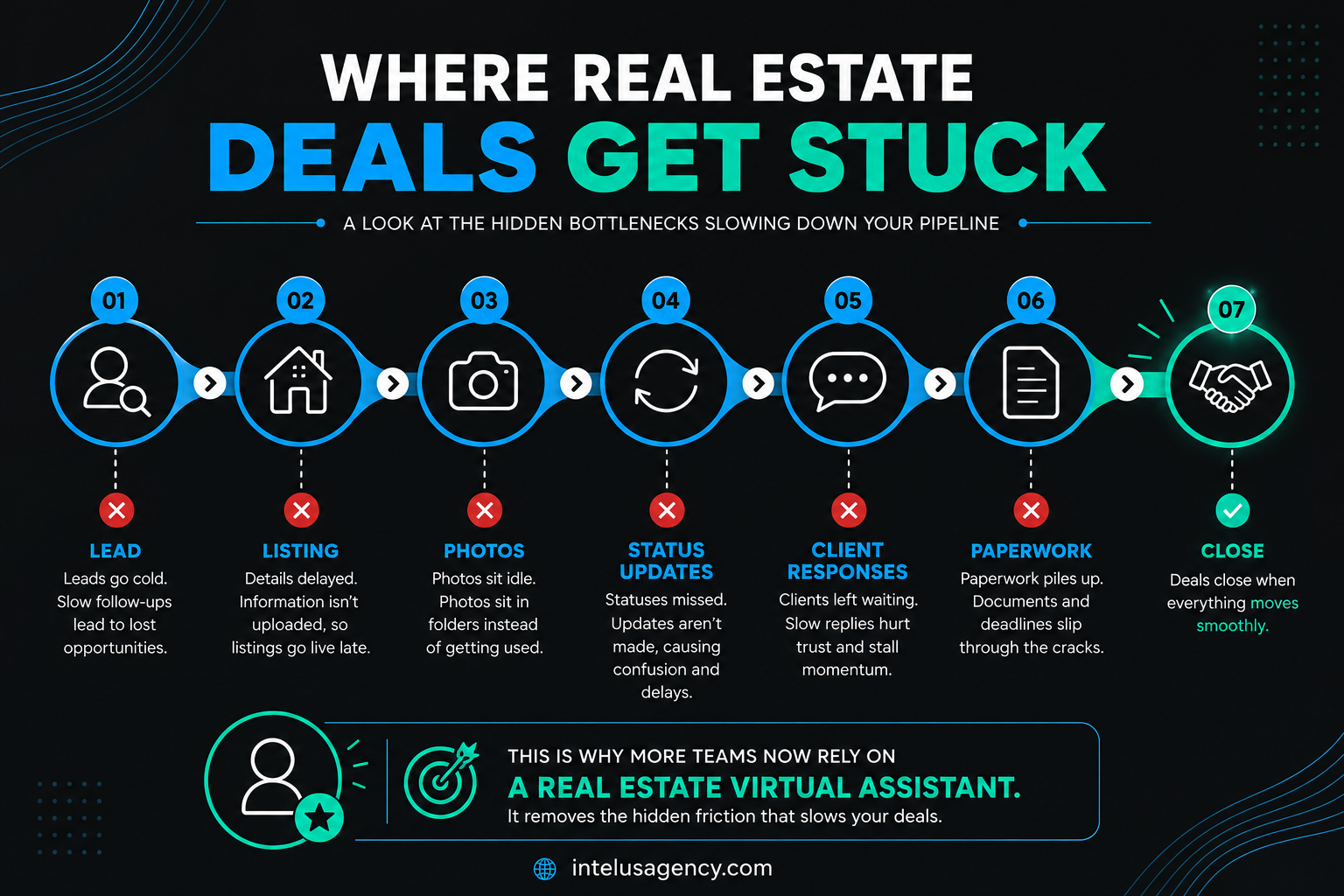
Many agents blame the market when deals slow down. But often, the slowdown happens inside the business.
Listings get delayed because details aren’t uploaded. Photos sit in folders. Statuses aren’t updated. Clients wait for responses. Paperwork piles up quietly. These problems are invisible, but they cost real money.
The data shared by the National Association of Realtors in their real estate research and statistics shows how time and efficiency affect transactions. Real estate is a timing game. Delays hurt momentum.
Industry coverage from Forbes in their real estate section talks about trends and prices, but behind every trend are thousands of small admin moments that decide if a deal survives.
Many brokers become the “human glue” of their pipeline. They remind clients. They track deadlines. They fix mistakes. They hold everything together. That’s not a growth plan. That’s survival mode.
This is why more teams now rely on a trained real estate operations assistant to keep listings, follow-ups, documents, and deadlines organised before small delays affect a deal.
What VA Real Estate Support Actually Means
Some people hear “virtual assistant” and imagine someone doing random tasks. That’s not what true VA real estate support is.
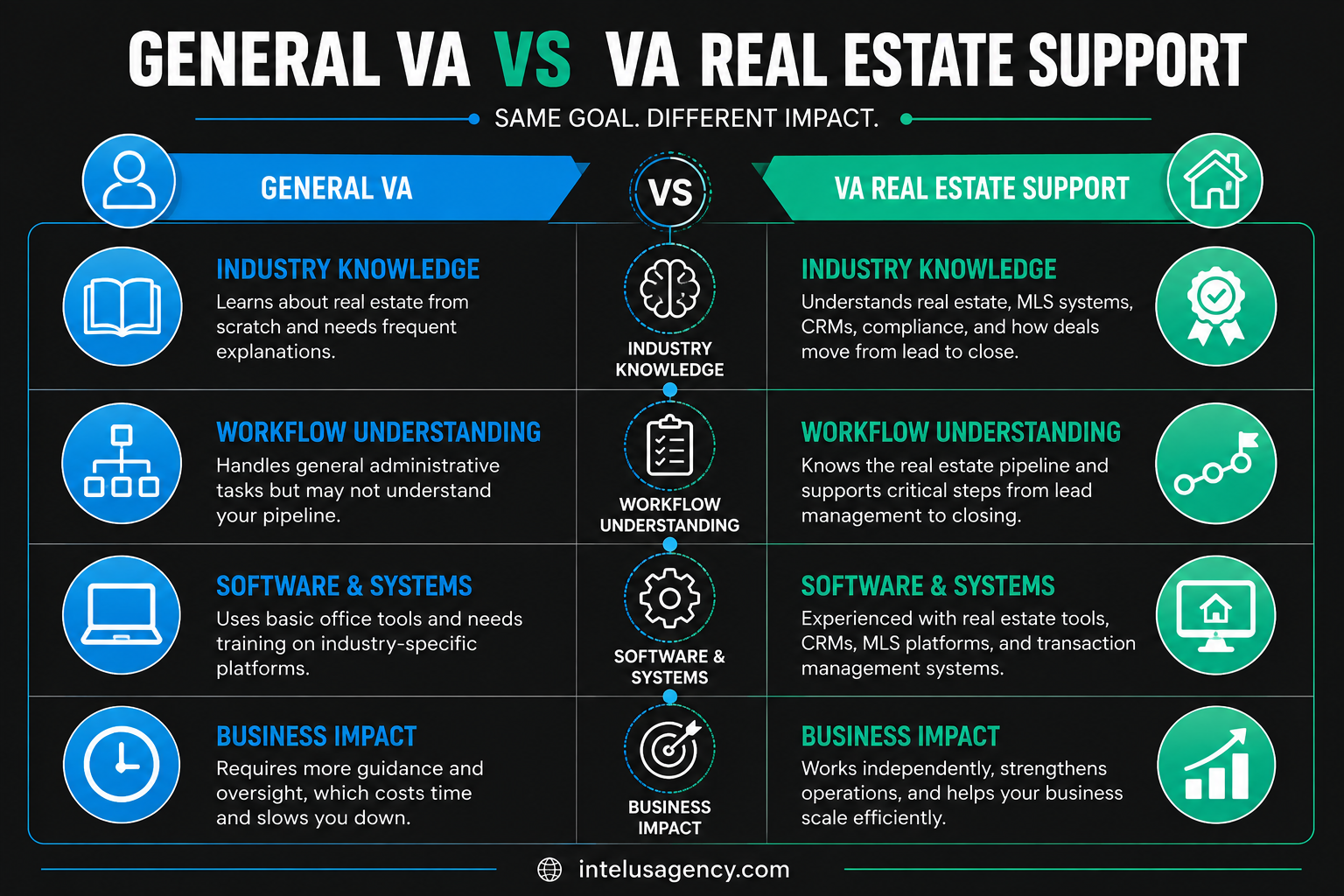
A real estate VA understands how deals move from lead to close. They know MLS systems. They understand CRMs. They track transaction timelines. They follow compliance steps.
They don’t just do tasks. They support a role in your operation.
A general VA might be organized, but they won’t know your pipeline. You’ll spend hours explaining things. A trained real estate VA already speaks your language.
Strong VA real estate support plugs into your system. It works with your tools. It supports your workflow. It feels like a team member, not a helper.
Many agencies pair this with strong project management support so nothing falls through the cracks.
Modern real estate also runs on technology. Platforms like HubSpot offer a powerful CRM system for tracking clients. Education hubs like Zillow provide helpful agent resources that show how top agents rely on systems, not memory.
Core VA Real Estate Roles That Keep Deals Moving
A strong VA real estate professional supports your pipeline in several ways.
Listing coordination is one of the biggest. They upload listings, check details, and make sure everything looks correct. That protects your brand and builds trust.
Transaction coordination matters just as much. From accepted offer to closing, many steps must be tracked. A VA keeps deadlines and documents organized.
CRM follow-up is where hidden revenue lives. Many leads convert months later. A VA keeps those conversations alive with steady check-ins.
Document prep and compliance keep deals safe. Missing paperwork can delay closings. Organized files speed them up.
Showing and appointment scheduling may seem small, but it eats hours every week. A VA handles the back-and-forth so your calendar stays clean.
Some leaders also use executive assistant support so high-level priorities stay focused.
Many real estate teams rely on Dotloop for smoother transactions, and their transaction management platform fits well into VA workflows.
How VA Real Estate Support Protects Deal Velocity
Deal velocity is simply how fast deals move from start to finish.
A VA keeps momentum steady. Files get updated the same day. Reminders go out before deadlines. Documents stay ready for signatures.
This reduces last-minute chaos. Agents stop reacting and start leading.
Research from McKinsey & Company in their real estate insights often points to operational efficiency as a growth driver. Smooth operations create better client experiences.
Clients feel when things are organized. They trust the process more. That trust turns into referrals.
The Big Idea: Your Pipeline Is a Conveyor Belt
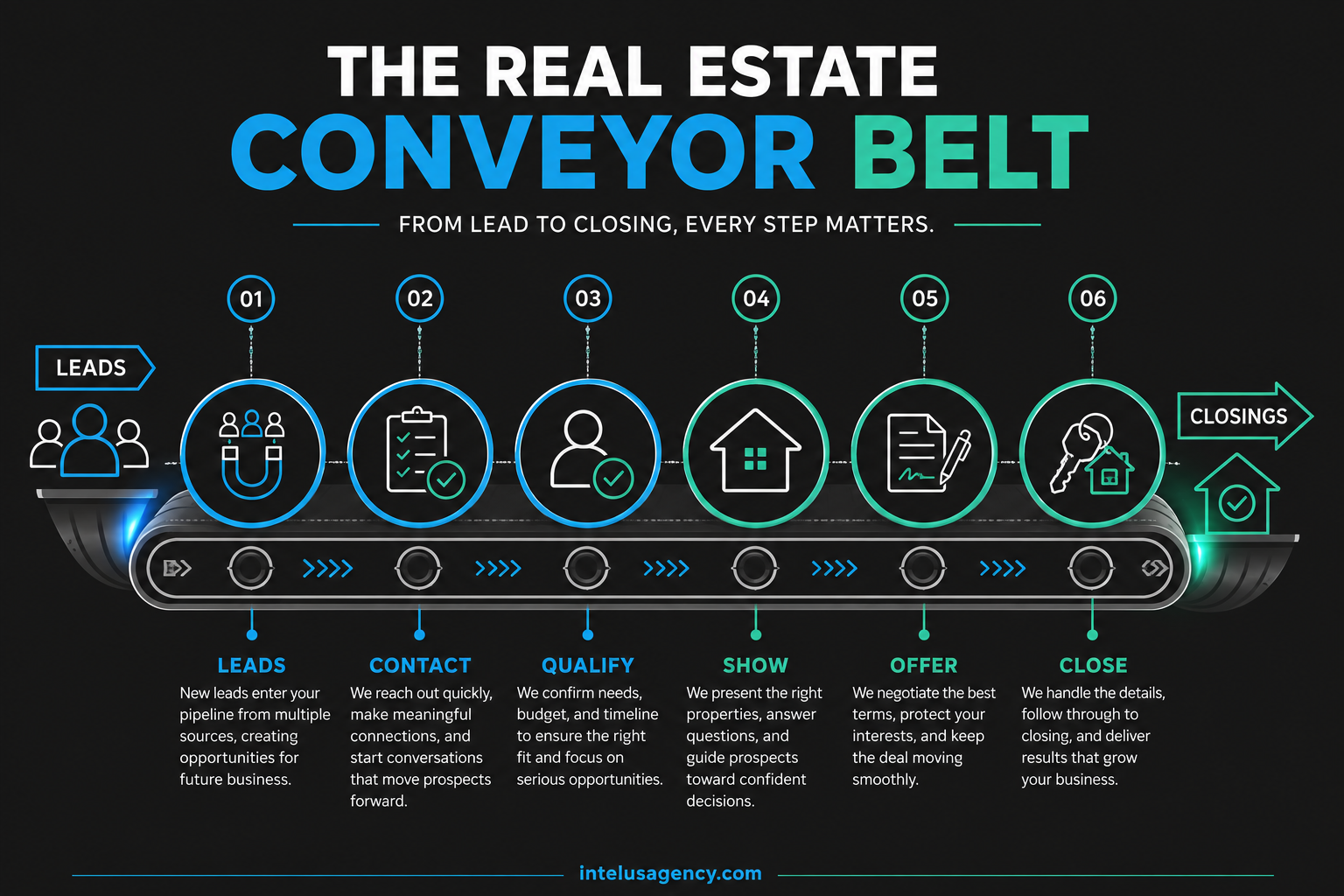
Imagine your business like a conveyor belt in a factory.
Leads enter on one side. Closings come out the other. In between are many steps that must stay aligned.
Agents are the deal-makers at the front. Closings are the finished product. VA real estate support is the motor that keeps everything moving.
If the belt slows, running faster beside it won’t fix it. Hustle can’t repair systems.
Systems scale. People burn out.
This is why growing teams see VAs as infrastructure. Not extras. Infrastructure.
You can see how structured support works on the Intelus Agency about page.
Tools VA Real Estate Professionals Must Master
Technology separates small teams from scalable ones.
MLS platforms are essential. CRMs track conversations. Many teams use Follow Up Boss and their real estate CRM system to manage pipelines.
Transaction tools organize paperwork. Scheduling tools prevent missed showings. Digital signing tools speed approvals.
A VA who understands these tools reduces errors. That protects your reputation.
Some teams also use dedicated CRM management support to keep data clean.
Scaling Property Pipelines Without Adding Headcount
Growth brings more admin. That’s reality.
One trained VA can remove 10 or more admin hours each week. That time goes back to revenue work.
Hiring in-house is slow and costly. Freelancers can be inconsistent. A trained VA inside your system brings stability.
Guides from Inc. on smart outsourcing and advice from the U.S. Small Business Administration in their business growth guide both highlight delegation as a scaling strategy.
Many teams review their options on the Intelus pricing page to plan growth.
What to Look for When Hiring VA Real Estate Support
Real estate workflow knowledge matters more than general admin skill.
Communication standards matter. Quick replies keep deals alive. Clear updates build trust.
Time zone overlap helps speed. Accountability systems protect quality.
Resources from the Society for Human Resource Management in their HR knowledge base and productivity guides from Asana in their team management resources both stress clear systems when hiring remote help.
Many brokers skip the trial-and-error phase by working with agencies that pre-train talent.
Final Thoughts: Smooth Pipelines Create Predictable Growth
Real estate will always have ups and downs. Your operations don’t have to.
Predictability beats hustle. Systems free leaders to lead. When your pipeline flows smoothly, stress drops and revenue stabilizes.
VA real estate support isn’t optional once you scale. It becomes your foundation.
If you want a smoother pipeline, start with an outsourcing consultation or explore a dedicated real estate virtual assistant.
A smooth pipeline doesn’t happen by luck. It happens by design. And the teams that design it well are the ones who grow without burning out.


.png)
.png)

.png)
.png)
