



Oops! Something went wrong while submitting the form.
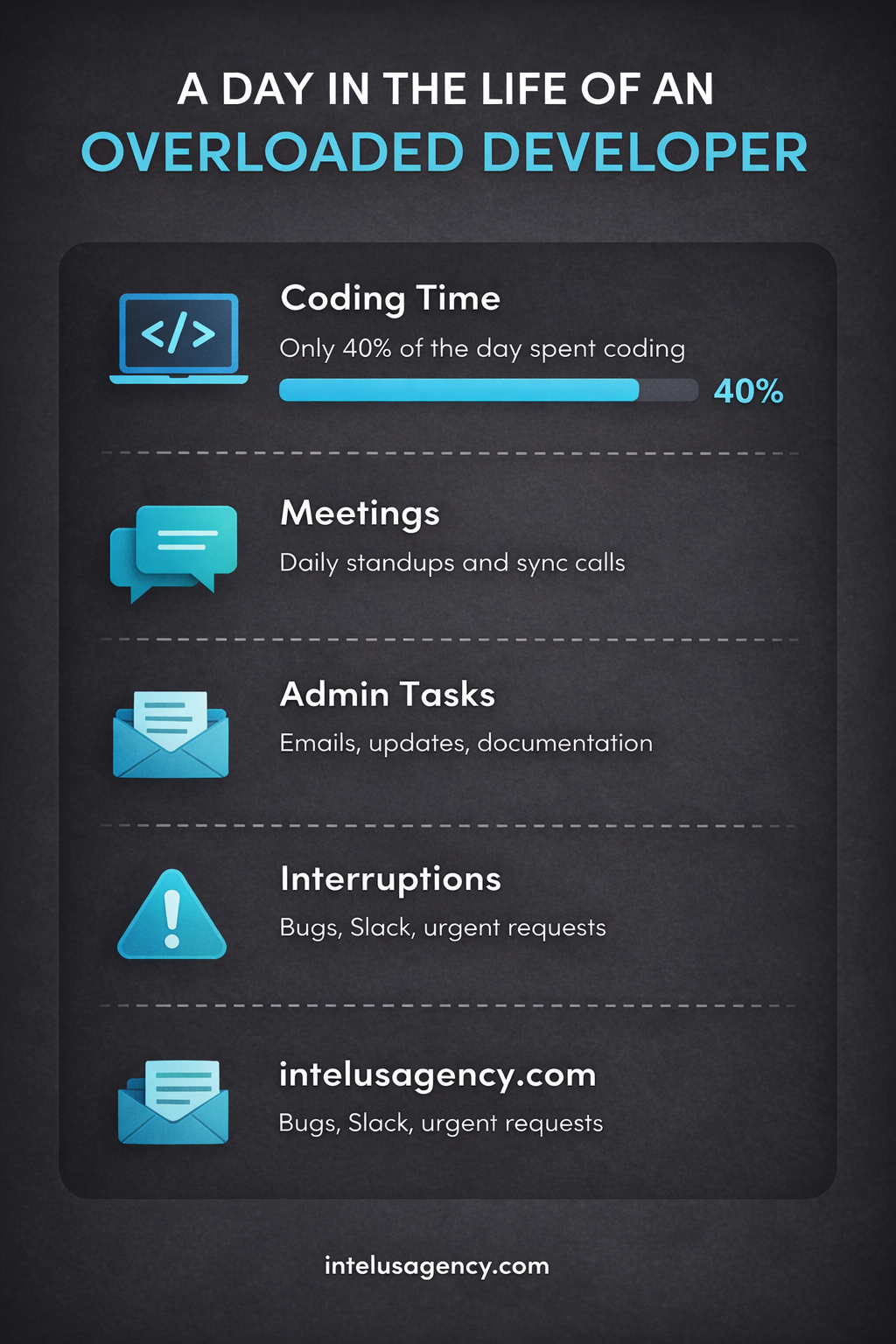
Modern developers aren’t just writing code anymore, they’re juggling testing, debugging, meetings, documentation, and even customer support. What used to be a focused craft has turned into a constant battle against interruptions.
Every context switch, jumping from coding to Slack messages to fixing minor bugs, comes at a cost. Studies on the impact of multitasking on productivity show that switching tasks can reduce efficiency dramatically. Combine that with rising demands and expectations, and it’s no surprise burnout is becoming the norm. Data from developer burnout statistics confirms what many already feel: developers are overwhelmed.
The real issue isn’t lack of skill, it’s overload.
When you try to do everything yourself, you slow down the one thing that actually matters: building.
The solution isn’t working harder. It’s working smarter through delegation.
What Is a Web Development Virtual Assistant?
A web development virtual assistant isn’t just another admin helper, they’re a specialized extension of your development workflow.
Unlike generic VAs, these professionals are trained to support technical environments. They understand the rhythm of development cycles, the structure of tasks in Agile systems, and the importance of clean, organized workflows.
Many come from backgrounds in QA testing, junior development, or tech-savvy support roles. That means they don’t just follow instructions, they anticipate needs inside your development pipeline.
They can plug directly into your existing systems, whether you're using Scrum sprints, Kanban boards, or hybrid workflows. Tools like Jira, Trello, Slack, and GitHub become shared environments where your assistant helps keep everything moving without interrupting your deep work.
Instead of pulling you away from coding, they handle the surrounding tasks that slow you down.
If you’ve ever wished you could focus purely on building while someone else handled the rest—this is exactly what a web development virtual assistant enables.
For example, businesses working with Intelus Agency gain access to:
These are not generalists, they are role-trained professionals built to support technical teams.
%20(1).png)
Tasks You Should NEVER Be Doing as a Developer
Here’s the uncomfortable truth: if you’re doing everything, you’re doing too much, and it’s costing you speed, focus, and growth.
Developers create the most value when they’re building systems, solving complex problems, and shipping features. But too often, high-impact engineers get buried in low-value, repetitive work.
These are the tasks you should immediately reconsider keeping on your plate:
Manual QA Testing
Clicking through flows, checking edge cases, and logging issues manually drains hours of deep work time. This is structured, repeatable work that a trained assistant can handle efficiently.
Data Entry and CMS Updates
Uploading blog posts, updating product pages, formatting content, none of this requires your engineering brain, yet it constantly interrupts your flow.
Documentation Writing
Writing user guides, updating internal docs, or formatting technical notes is essential, but it doesn’t always require you. A web development virtual assistant can draft and organize this based on your input.
Bug Tracking and Reporting
Triaging bugs, organizing tickets, and writing reports are necessary for clean development cycles, but they don’t need to pull you out of coding.
Customer Support Triaging
Answering technical questions, sorting support tickets, and escalating real issues can consume hours. This is one of the fastest ways to lose focus daily.
Basic DevOps and Routine Tasks
Running deployments, monitoring logs, or handling simple environment setups, these are critical but often repetitive processes that can be delegated with proper SOPs.
If you’re still handling these, you’re effectively paying a developer’s rate for tasks that don’t require one.
That’s where support systems like administrative virtual assistant services come inallowing you to offload operational noise while maintaining control.
%20(1).png)
How Delegation Helps You Ship Faster (Without Hiring More Engineers)
Speed in development isn’t just about writing code faster, it’s about removing everything that slows code down.
When you delegate effectively to a web development virtual assistant, you unlock something most teams struggle to achieve: uninterrupted deep work.
Developers do their best work when they’re fully focused. No interruptions. No task switching. Just building. By offloading repetitive and support tasks, you create space for longer, more productive coding sessions, where real progress happens.
More Deep Work, Less Context Switching
Instead of bouncing between tickets, messages, and minor fixes, you stay in flow. That alone can dramatically increase output without adding more hours.
Faster Sprint Cycles
When someone else is handling QA prep, documentation, and task updates, your sprints move cleaner and faster. Bottlenecks disappear because work is happening in parallel.
Reduced Bottlenecks
A virtual assistant ensures that tasks don’t pile up waiting for you. While you code, they’re updating boards, organizing tickets, and keeping workflows moving.
Cleaner Pipelines and Workflows
With consistent support, your development pipeline becomes structured instead of reactive. Everything is tracked, documented, and maintained in real time.
Parallel Execution = Real Scale
Instead of being a one-person bottleneck, you now have multiple processes running simultaneously. You build while your assistant supports the system around you.
This is exactly why companies that hire remote specialists scale faster, not because they work more, but because they work in parallel.
.png)
ROI of Hiring a Web Development Virtual Assistant
If you’re evaluating whether a web development virtual assistant is worth it, the real question isn’t cost, it’s return.
Because what you’re actually buying isn’t just support… it’s speed, focus, and output.
Cost Comparison: VA vs Developer Salary
Hiring another full-time developer is expensive, and often unnecessary for non-core tasks. A virtual assistant handles support work at a fraction of the cost, freeing your developers to focus on what actually drives value.
The Opportunity Cost of Developer Time
Every hour you spend on admin, QA, or documentation is an hour not spent building features, improving systems, or shipping updates.
That lost time compounds. Slowly at first, then dramatically.
Faster Product Releases = More Revenue
When your development pipeline moves faster, your product hits the market sooner. Features get released quicker. Feedback loops tighten. Revenue opportunities open earlier.
Speed isn’t just a productivity metric, it’s a growth lever.
Reduced Churn and Technical Debt
When developers are overloaded, shortcuts happen. Documentation gets skipped. Bugs pile up. Systems become harder to maintain.
A virtual assistant helps keep everything organized, tracked, and documented, reducing long-term technical debt and improving team efficiency.
This is why more founders are choosing to hire a web development virtual assistant, not as a cost-saving move, but as a scaling strategy.
.png)
How to Integrate a Virtual Assistant Into Your Dev Team
Bringing in a web development virtual assistant doesn’t have to be complicated. In fact, the smoother your onboarding process, the faster you’ll start seeing results.
The key is to treat integration as a system, not a one-time handoff.
Start With SOPs and Repeatable Tasks
Begin by identifying tasks you do repeatedly: QA testing, ticket updates, documentation, deployments. Turn these into simple SOPs (Standard Operating Procedures). This creates clarity and eliminates guesswork from day one.
Use the Same Tools Your Team Already Uses
Your VA should operate inside your existing stack:
- Jira for task tracking
- Trello for workflow visibility
- Slack for communication
- GitHub for version control support
If you already know how to use Jira for teams, you’re halfway there, your VA simply becomes another contributor in that system.
Daily Standups or Async Updates
Include your assistant in standups or async check-ins. Even a quick daily update ensures alignment and prevents small issues from becoming blockers.
Define Clear KPIs and Expectations
Set measurable outcomes:
- Number of QA tests completed
- Tickets updated or resolved
- Documentation accuracy
- Response times
Clarity removes friction and builds accountability.
Expand Responsibilities Gradually
Start small. Once trust and rhythm are established, increase task complexity. Many assistants evolve into critical workflow managers over time.
The goal isn’t just support, it’s creating a system that runs smoothly without constant intervention from you.
.png)
The Hidden Advantage, Better Code Quality (Not Just Speed)
Most developers think a web development virtual assistant is about saving time.
But the bigger advantage? Better code.
When you’re no longer rushing between tasks, your entire development process improves, not just your speed, but your standards.
Cleaner Documentation
With a VA maintaining and organizing documentation, your systems become easier to understand, onboard, and scale. Nothing gets lost or skipped.
More Consistent QA Processes
Instead of ad hoc testing, QA becomes structured and repeatable. Every release goes through the same level of scrutiny, reducing regressions and surprises.
Better Bug Reporting
Clear, detailed bug reports mean less time guessing and more time fixing. Your assistant ensures issues are documented properly, with steps, screenshots, and context.
Less Rushed Coding
When you’re not overloaded, you don’t cut corners. You write cleaner, more maintainable code because you actually have the mental space to think.
Improved Maintainability
Well-documented systems, organized workflows, and consistent processes make your codebase easier to scale and manage over time.
These practices align with proven software code quality principles, where clarity, simplicity, and maintainability drive long-term success.
Delegation doesn’t lower standards, it reinforces them.
%20(1).png)
The “Second Brain Developer” Concept
Here’s a different way to think about a web development virtual assistant, not as support, but as an extension of your mind.
Imagine your brain like a CPU.
It has limited threads. Limited processing power. And every time you switch tasks, you lose efficiency.
Now think about what happens when you try to manage coding, debugging, meetings, documentation, and support, all at once.
You’re running as a single-threaded system.
Slow. Overloaded. Constantly interrupted.
Now introduce a virtual assistant.
Suddenly, everything changes.
Your assistant becomes your “Second Brain”, handling the processes your mind shouldn’t be wasting energy on.
Your VA as RAM
They take on active tasks in parallel, QA, updates, documentation, so your brain doesn’t have to juggle everything at once.
Your VA as Cache
They store repeatable processes, SOPs, and workflows, so you don’t have to relearn or rethink tasks every time.
Your VA as Background Processes
They run ongoing operations silently, updating tickets, organizing tasks, monitoring workflows, without interrupting your focus.
Without a VA, you’re doing everything manually.
With a VA, you become a distributed system.
From Doer to Architect
Instead of reacting to tasks, you start designing systems. You think bigger. You build smarter. You scale faster.
This shift is grounded in concepts like cognitive load theory explained, which shows that reducing mental overload improves performance, learning, and decision-making.
Delegation isn’t just operational, it’s cognitive optimization.
%20(1).png)
Common Mistakes When Hiring a Virtual Assistant (And How to Avoid Them)
Hiring a web development virtual assistant can transform your workflow, but only if you do it right.
Many developers fail not because the idea is wrong, but because the execution is flawed. Here are the most common mistakes, and how to avoid them.
Hiring a Generic VA Instead of a Role-Trained One
Not all virtual assistants are built for technical environments. A generic VA may struggle with tools, workflows, and terminology.
Instead, look for role-specific support like experienced remote project support or technical assistants who understand development ecosystems.
Lack of SOPs
If your processes live only in your head, your VA won’t succeed. Without clear instructions, tasks become inconsistent and frustrating.
Solution: document repeatable workflows before delegating.
Poor Communication Systems
Relying on random messages or unclear instructions creates confusion. Your VA should be integrated into structured communication channels like Slack or task boards.
Unrealistic Expectations
A VA is not a mind reader. Expecting instant perfection without onboarding or training leads to disappointment.
Start small, provide feedback, and scale gradually.
Not Tracking Performance
If you’re not measuring output, you’re guessing. Set clear KPIs and track progress to ensure continuous improvement.
Strong systems matter. Even insights from “managing remote teams effectively” emphasize clarity, communication, and structured processes as the foundation of high-performing remote teams.
Avoid these mistakes, and your VA becomes an asset, not a risk.
.png)
When Is the Right Time to Hire a Web Development Virtual Assistant?
Most developers wait too long.
They wait until they’re overwhelmed. Until deadlines are missed. Until growth starts to stall.
But by then, the cost of delay has already compounded.
The right time to hire a web development virtual assistant is earlier than you think, specifically when you start noticing these signals:
You’re Spending Less Than 50% of Your Time Coding
If your day is filled with admin work, meetings, bug tracking, and support tasks, your highest-value skill is being underutilized.
Your Backlog Keeps Growing
Features, fixes, and improvements keep piling up, but you can’t seem to catch up. That’s not a productivity issue, it’s a capacity issue.
You’re Missing Deadlines
When everything depends on you, everything slows down. Bottlenecks become inevitable.
You Feel Constantly Overwhelmed
Mental fatigue, context switching, and task overload are clear indicators that your current system isn’t sustainable.
You’re Scaling or Onboarding Clients
Growth increases complexity. Without support, what should be progress quickly turns into chaos.
Hiring isn’t just about solving problems, it’s about preventing them.
The earlier you delegate, the faster you build a system that can handle scale.

Conclusion
At some point, every developer hits the same ceiling.
Not because they lack skill, but because they’re trying to do everything alone.
The reality is simple: the more time you spend juggling tasks, the less time you spend building. And building is where the real value lives.
A web development virtual assistant changes that equation.
Instead of stretching yourself thin, you create leverage. You focus on high-impact work while everything else continues to move in the background. You ship faster, think clearer, and scale without burning out.
This isn’t about working harder.
It’s about working like a system.
The developers and founders who grow the fastest aren’t the ones doing the most, they’re the ones who delegate the smartest.
If you’re ready to reduce stress, increase output, and build with focus again, the next step is simple, hire a web development virtual assistant or find role-trained web development support


.png)
.png)

.png)
.png)
