



Oops! Something went wrong while submitting the form.
In today’s hyper-competitive real estate market, speed isn’t just an advantage, it’s the difference between winning and losing deals.
The reality is simple: the first agent to respond often gets the client. Buyers and sellers are moving fast, and attention spans are shorter than ever. If you’re not responding within minutes, someone else is.
According to industry insights from the National Association of Realtors, response time plays a critical role in conversion rates. Pair that with data from HubSpot, and its clear delays directly cost you revenue.
But here’s the problem: most agents aren’t slow because they’re lazy. They’re overwhelmed.
You’re juggling:
- Lead inquiries
- Follow-ups
- Showings
- Paperwork
- Marketing
And somewhere in that chaos, opportunities slip through the cracks.
This is where a role-trained real estate support professional becomes a game changer.
Instead of trying to do everything yourself, a virtual assistant ensures:
- Every lead gets an immediate response
- Every follow-up actually happens
- Your pipeline keeps moving even when you’re busy closing
Speed creates momentum. Momentum closes deals.
And the agents who build systems around speed? They win.
.png)
What Is a Virtual Assistant for Real Estate?
A virtual assistant for real estate is a remote professional trained to handle the operational, administrative, and marketing tasks that keep your business running.
Unlike a traditional in-office assistant, a virtual assistant works remotely yet integrates seamlessly into your daily workflow. They log into your systems, manage your processes, and support your clients as if they were sitting right next to you.
These assistants are not generalists, they’re often role-trained specifically for real estate, meaning they understand the tools and workflows you already use, including CRMs, MLS platforms, email systems, and transaction coordination software.
According to Investopedia, virtual assistants provide businesses with flexible, scalable support without the long-term costs of full-time employment. In real estate, that flexibility is a massive advantage.
What Makes Them Different from In-House Assistants?
The biggest difference comes down to cost, flexibility, and specialization.
An in-house assistant requires:
- Salary
- Office space
- Equipment
- Benefits
- Training
A virtual assistant, on the other hand, offers:
- Lower monthly cost
- No overhead expenses
- Immediate productivity
- Specialized real estate experience
This means you can scale your support without increasing your fixed costs.
If you're looking to hire virtual assistants or explore flexible remote staffing solutions, this model allows you to grow without the traditional hiring risks.
Types of Real Estate Virtual Assistants
Not all VAs are the same. Depending on your needs, you can hire specialists such as:
- Administrative VAs for paperwork and scheduling
- Marketing VAs for listings and social media
- Sales support VAs for lead follow-ups
- Transaction coordinators for closing processes
For example, virtual administrative assistants can handle backend tasks, while digital marketing assistants focus on lead generation and visibility.
This specialization is what transforms a VA from “extra help” into a revenue-driving asset.
The Hidden Bottlenecks Slowing Down Your Deals
Most real estate agents don’t have a lead problem, they have a workflow problem.
Deals aren’t lost because there’s no demand. They’re lost in the gaps between tasks, systems, and follow-ups. These hidden bottlenecks quietly slow down your pipeline and cost you commissions without you even realizing it.
Let’s break down where things typically go wrong.
1. Manual Lead Follow-Ups
Every new inquiry is an opportunity but without a system, follow-ups become inconsistent.
You tell yourself you’ll reply later. Then showings happen. Calls stack up. By the time you circle back, the lead has already moved on.
Speed matters but consistency matters more.
2. CRM Mismanagement
Your CRM should be your command center but for many agents, it’s a graveyard of outdated contacts and missed reminders.
Without proper organization and automation (as recommended by Salesforce), you lose:
- Visibility into your pipeline
- Timely follow-ups
- Opportunities to nurture leads
A messy CRM = missed deals.
3. Listing Coordination Delays
Photos, descriptions, uploads, updates, listing coordination is detail-heavy and time-sensitive.
If any step is delayed:
- Listings go live late
- Buyers lose interest
- Momentum disappears
And in real estate, momentum is everything.
4. Paperwork & Compliance Backlog
Contracts, disclosures, signatures it’s endless.
When paperwork piles up:
- Deals slow down
- Errors increase
- Closings get delayed
Instead of moving deals forward, you’re stuck catching up.
5. Inconsistent Marketing
You know you should be posting, emailing, and promoting consistently, but it often falls to the bottom of your priority list.
The result?
- Lower visibility
- Fewer inbound leads
- Unpredictable deal flow
The Real Problem
These bottlenecks don’t just slow you down, they compound.
One missed follow-up leads to a lost client.
One delayed listing leads to reduced interest.
One messy system leads to total pipeline confusion.
And suddenly, your business feels harder than it should be.
This is exactly why many agents turn to a real estate virtual assistant, not just to “help,” but to remove friction from every stage of the deal cycle.
Tasks a Real Estate Virtual Assistant Can Handle
One of the biggest advantages of hiring a virtual assistant for real estate is simple: you stop doing everything yourself.
Instead of juggling dozens of small but critical tasks, you delegate them to someone trained to handle them efficiently, freeing you up to focus on what actually makes money: closing deals.
Here’s what a real estate virtual assistant can take off your plate.
Lead Management & Follow-Ups
Speed and consistency are everything in lead conversion.
A VA ensures:
- Immediate responses to new inquiries
- Automated and manual follow-up sequences
- No lead gets forgotten
Using tools like real estate CRM systems, they keep your pipeline active and engaged at all times.
CRM Updates & Pipeline Management
Your CRM is only powerful if it’s maintained properly.
A virtual assistant can:
- Update contact records
- Tag and segment leads
- Track deal stages
- Set reminders and workflows
This gives you a clear, real-time view of your business without the admin burden.
Appointment Setting & Calendar Management
Coordinating showings, calls, and meetings can quickly become overwhelming.
A VA handles:
- Scheduling appointments
- Sending confirmations and reminders
- Managing calendar conflicts
Result? Fewer missed opportunities and smoother client experiences.
Listing Coordination
From pre-listing to going live, there are many moving parts.
A virtual assistant can:
- Upload listings to MLS
- Coordinate photos and descriptions
- Ensure everything is published on time
No more delays. No more last-minute stress.
Email & Communication Management
Your inbox shouldn’t control your day.
A VA can:
- Respond to routine inquiries
- Organize and prioritize messages
- Maintain consistent communication with clients
This keeps your business responsive even when you’re busy in showings.
Social Media & Marketing Support
Consistency builds visibility, and visibility drives leads.
With support from digital marketing assistants, a VA can:
- Schedule posts
- Create listing promotions
- Manage engagement
You stay top-of-mind without doing the daily work.
Transaction Coordination
Once a deal is in motion, details matter.
A VA can:
- Manage documents and signatures
- Track deadlines
- Coordinate with buyers, sellers, and brokers
This ensures every deal moves smoothly toward closing.
The Big Shift
When you delegate these tasks, something powerful happens:
You stop being an overwhelmed operator and start becoming a focused dealmaker.
If you’re ready to hire virtual assistants or explore virtual administrative assistants, this is where the transformation begins.

How a Virtual Assistant Helps You Close Deals Faster
At the core of every successful real estate business is one thing: speed with consistency.
A virtual assistant for real estate doesn’t just “help” with tasks, they actively accelerate your entire deal pipeline. From the first inquiry to the final signature, they remove delays that typically cost you deals.
Here’s how that translates directly into faster closings.
Instant Lead Response
The moment a lead comes in, your virtual assistant is already on it.
No delays. No missed messages.
This means:
- You become the first agent to engage
- You capture attention while interest is high
- You dramatically increase conversion chances
In real estate, speed isn’t optional, it’s a competitive weapon.
Consistent Follow-Up Sequences
Most deals aren’t lost on the first contact, they’re lost in the follow-up.
A VA ensures:
- Every lead gets nurtured
- Follow-ups happen daily, not randomly
- No opportunity slips through the cracks
Consistency builds trust, and trust closes deals.
Better Pipeline Visibility
When your CRM is properly managed, you gain something powerful: clarity.
With a VA maintaining your system, you can:
- See exactly where every deal stands
- Identify hot leads instantly
- Prioritize high-value opportunities
No more guessing. Just informed action.
More Time for High-Value Activities
Every minute you’re doing admin work is a minute you’re not:
- Showing properties
- Negotiating offers
- Building client relationships
A virtual assistant gives you that time back.
And that’s where the real money is made.
Improved Client Experience
Fast responses. Organized communication. Smooth transactions.
When clients feel taken care of, they:
- Trust you more
- Stay engaged
- Refer you to others
A VA helps you deliver a premium experience at scale.
The Real Outcome: Deal Acceleration
When you combine:
- Instant response
- Consistent follow-ups
- Organized systems
- More selling time
You create a system where deals move faster naturally.
This is why agents who leverage real estate virtual assistants consistently outperform those trying to do everything alone.
.png)
ROI of Hiring a Virtual Assistant for Real Estate
Hiring a virtual assistant for real estate isn’t an expense, it’s an investment with measurable returns.
Most agents hesitate at first because they see the monthly cost. But when you shift your perspective from cost to ROI, the math becomes very clear.
Cost vs Commission: The Real Equation
Let’s break it down.
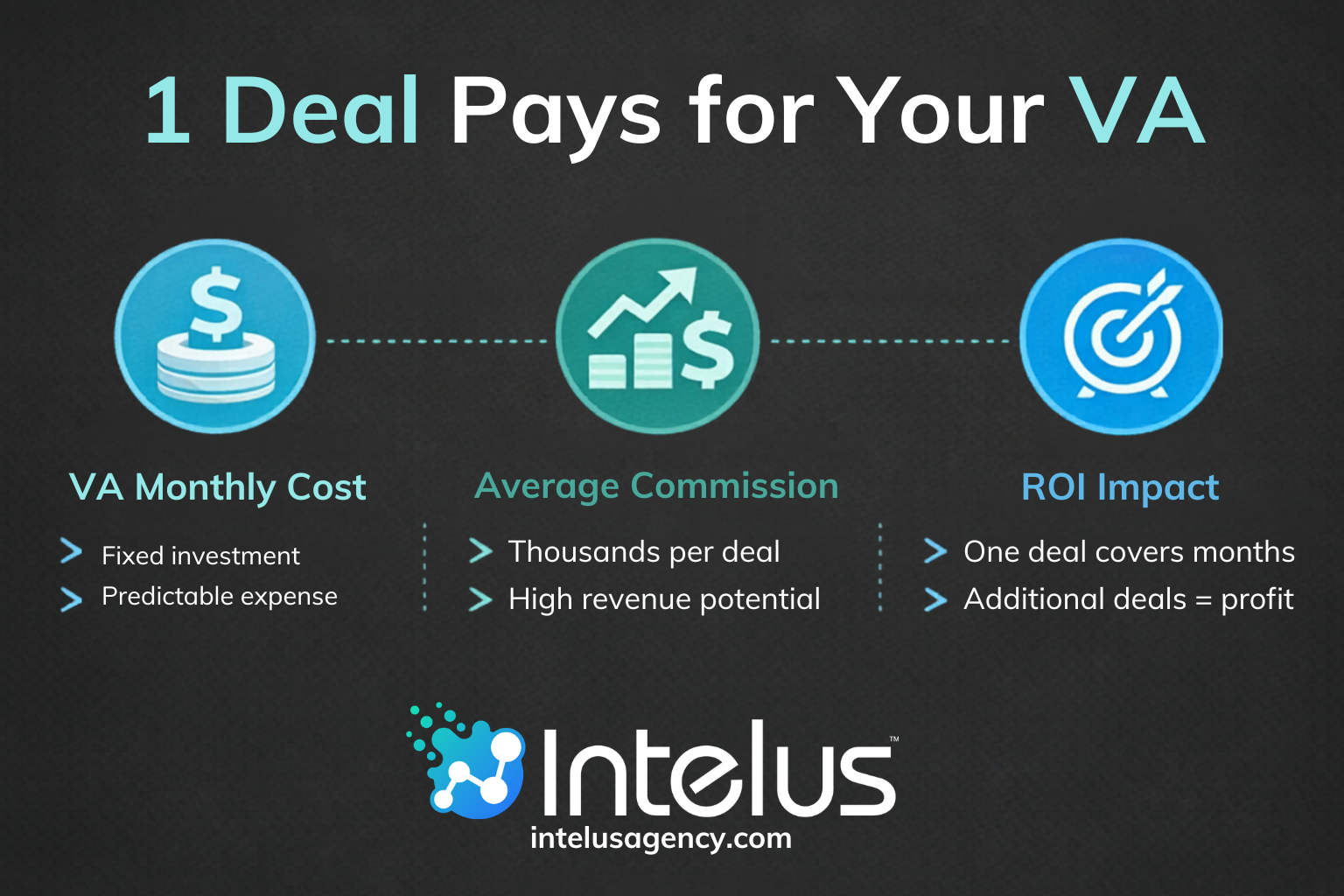
A virtual assistant typically costs a fixed monthly rate. Meanwhile, a single real estate deal can generate thousands in commission.
According to Zillow, commissions can range significantly depending on the market, but even one closed deal can cover multiple months of VA support.
That means:
- 1 extra deal = months of operational support covered
- Every additional deal = increased profit
Increased Capacity Without Burnout
Without support, your capacity is limited by your time.
With a VA:
- You handle more leads
- You follow up consistently
- You manage more transactions simultaneously
All without working longer hours.
This is how you scale without burning out.
Predictable Scaling
One of the biggest challenges in real estate is inconsistency.
Some months are great. Others are slow.
A virtual assistant helps stabilize your business by:
- Keeping your pipeline active
- Maintaining consistent outreach
- Ensuring no lead is wasted
The result? More predictable deal flow and revenue.
The Smart Agent’s Perspective
Top-performing agents don’t ask:
“Can I afford a VA?”
They ask:
“How many deals am I losing without one?”
Because the real cost isn’t hiring help, it’s staying stuck doing low-value tasks.
If you’re serious about growth, exploring remote staffing solutions or choosing to hire virtual assistants is one of the highest-leverage decisions you can make.
What to Look for in a Real Estate Virtual Assistant
Not all virtual assistants are created equal.
Hiring the right virtual assistant for real estate can dramatically improve your business, but choosing the wrong one can create more problems than it solves.
Here’s how to make the right choice.
Real Estate Experience (Non-Negotiable)
A general VA might be helpful but a real estate-trained VA is a game changer.
Look for someone who understands:
- MLS systems
- CRM platforms
- Transaction coordination workflows
- Listing processes
This eliminates the need for heavy training and allows them to contribute immediately.
If you’re exploring real estate virtual assistants, prioritize candidates who already speak your industry’s language.
Strong Communication Skills
Your VA will often be interacting with:
- Leads
- Clients
- Vendors
Clear, professional communication is critical.
They should be able to:
- Respond promptly
- Write well-structured emails
- Maintain a consistent tone that reflects your brand
Because to your clients they are part of your team.
Time Zone Alignment
Speed only works if your VA is available when your leads are active.
Make sure:
- Their working hours align with your market
- They can respond in real-time when needed
This ensures you maintain the speed advantage discussed earlier.
Reliability & Accountability
Consistency builds trust not just with clients, but within your operations.
Look for a VA who:
- Meets deadlines
- Follows processes
- Takes ownership of tasks
You don’t want someone you have to chase, you want someone you can rely on.
Role-Trained vs General VA
This is where most agents make mistakes.
Hiring a cheap, general freelancer may save money upfront but often leads to:
- Poor execution
- Constant supervision
- Inconsistent results
A role-trained VA, on the other hand:
- Already understands real estate workflows
- Requires minimal onboarding
- Delivers faster results
This is why many agents choose structured providers when they hire virtual assistants to ensure quality and reliability from day one.
The Bottom Line

The right VA doesn’t just “assist” they amplify your productivity.
The wrong one? They slow you down.
Choose carefully.
Why Most Agents Fail When Hiring VAs (And How to Avoid It)
Hiring a virtual assistant for real estate can be one of the smartest moves you make, but only if you do it right.
Unfortunately, many agents have a bad first experience. Not because virtual assistants don’t work, but because of how they hire and manage them.
Let’s break down the most common mistakes, and how to avoid them.
1. Hiring Cheap, Untrained Freelancers
The biggest trap? Choosing price over quality.
Low-cost freelancers often:
- Lack real estate experience
- Require constant supervision
- Deliver inconsistent results
What seems like savings quickly turns into frustration, and lost deals.
Instead, invest in role-trained professionals who already understand your workflow. This is why many agents turn to structured providers when they hire virtual assistants.
2. No Onboarding Process
Even the best VA will struggle without proper onboarding.
Common mistakes include:
- No clear task instructions
- No system access setup
- No defined expectations
To fix this:
- Document your processes
- Provide tool access early
- Start with clear, repeatable tasks
A little structure upfront creates long-term efficiency.
3. Poor Communication Systems
If communication is unclear, everything slows down.
Without a system:
- Tasks get missed
- Priorities get confused
- Frustration builds on both sides
Use tools and set expectations for:
- Daily updates
- Task tracking
- Response times
As highlighted by Forbes, managing remote team members effectively requires structured communication and accountability.
4. No Defined KPIs
You can’t improve what you don’t measure.
Many agents fail because they never define:
- Response time targets
- Number of follow-ups
- Tasks completed per day
Without KPIs, your VA is guessing what success looks like.
With KPIs, performance becomes measurable, and scalable.
5. Treating the VA Like “Extra Help”
This is a mindset problem.
If you treat your VA like an afterthought:
- You won’t delegate properly
- You’ll keep doing everything yourself
- You’ll never see real results
Instead, treat your VA like a core part of your business system.
Because that’s exactly what they are.
The Reality
Most failures don’t come from hiring a VA.
They come from:
- Lack of structure
- Lack of clarity
- Lack of commitment to delegation
Avoid these mistakes, and your VA becomes one of your biggest competitive advantages.
.png)
(Big Idea) The “Leaky Bucket” of Real Estate Deals
Imagine your real estate business as a bucket.
At the top, you’re pouring in leads from ads, referrals, cold outreach, social media. You’re doing everything right to generate opportunities.
But there’s a problem.
Your bucket is leaking.
Not from one big hole but from dozens of small ones.
- A missed follow-up here
- A delayed response there
- A forgotten task
- An overloaded day
Individually, they don’t seem like a big deal.
But together?
They quietly drain your pipeline.
The Illusion of “More Leads”
Most agents respond to this problem the wrong way.
They think:
“I just need more leads.”
So they:
- Spend more on ads
- Double down on prospecting
- Push harder on marketing
But pouring more water into a leaking bucket doesn’t fix the problem.
It just wastes more of it.
Where the Leaks Come From
In real estate, the biggest leaks are operational:
- Slow response times
- Inconsistent follow-ups
- Disorganized systems
- Administrative overload
- Burnout
These aren’t marketing problems.
They’re execution problems.
The Shift: Plugging the Leaks
This is where a virtual assistant for real estate changes everything.
A VA doesn’t just add capacity they seal the system.
They:
- Respond instantly
- Follow up consistently
- Keep your CRM organized
- Handle the tasks that create delays
Suddenly, your bucket holds water.
The Breakthrough Insight
When your system is tight:
- Every lead gets attention
- Every opportunity is maximized
- Every effort compounds
You don’t need more leads.
You need to stop losing the ones you already have.
From Leaking to Compounding
Before:
- Leads come in → deals fall through
- Effort increases → results stay flat
After:
- Leads come in → deals move forward
- Effort compounds → revenue grows
That’s the difference between a chaotic business…
and a scalable one.
%20(1).png)
How to Get Started with a Real Estate Virtual Assistant
Getting started with a virtual assistant for real estate doesn’t have to be complicated.
In fact, the agents who see the fastest results are the ones who keep it simple, structured, and focused from day one.
Here’s how to do it right.
1. Define the Role and Tasks
Start with clarity.
Ask yourself:
- What tasks slow me down the most?
- What do I repeat every day or week?
- What doesn’t require my direct involvement?
Common starting points include:
- Lead follow-ups
- CRM updates
- Scheduling
- Listing coordination
The clearer the role, the faster your VA becomes productive.
2. Choose the Right Experience Level
Not all VAs are the same, and that’s a good thing.
You can choose based on your needs:
- Entry-level VA → Basic admin tasks
- Specialist VA → CRM, marketing, coordination
- Expert VA → Full pipeline support, automation, and optimization
If you want faster results with less training, working with providers that offer real estate virtual assistants is often the smartest path.
3. Set Up a Simple Onboarding Process
You don’t need a complicated system, just a clear one.
Start with:
- Access to your CRM, email, and calendar
- A list of daily and weekly tasks
- Simple process documentation (even bullet points work)
This ensures your VA can start contributing almost immediately.
4. Set Expectations and KPIs
Clarity drives performance.
Define:
- Response time targets
- Number of follow-ups per day
- Task completion expectations
This creates accountability, and measurable results.
5. Start Small, Then Scale
You don’t need to delegate everything on day one.
Start with a few key tasks.
Build trust.
Refine the process.
Then expand.
Before you know it, your VA becomes an essential part of your business engine.
If you're ready to explore remote staffing solutions or confidently hire virtual assistants, this is your starting point.
CONCLUSION
Real estate doesn’t reward the busiest agents.
It rewards the most efficient ones.
You don’t need more hours in your day, you need leverage.
A virtual assistant for real estate gives you that leverage by:
- Turning chaos into systems
- Replacing delays with speed
- Converting missed opportunities into closed deals
Because at the end of the day:
Faster response = more conversations
More conversations = more deals
And more deals? That’s growth.
Close More Deals Without Doing More Work
Stop losing deals due to slow follow-up and admin overload.
Hire a role-trained virtual assistant for real estate and start scaling with confidence or book a consultation to get matched with the right VA


.png)


.png)
.png)
