



Oops! Something went wrong while submitting the form.
Artificial intelligence is transforming the way businesses approach marketing. From generating captions to analyzing campaign performance, AI tools in marketing (https://www.nist.gov/artificial-intelligence?utm_source=chatgpt.com) promise faster execution and lower costs. As a result, many companies are asking whether they still need a social media marketing manager or if AI can handle everything on its own.
The question is understandable. Budgets are under pressure, and automation continues to improve at an impressive pace. However, successful social media marketing has never been about producing content alone. It requires understanding customer behavior, aligning campaigns with business objectives, adapting to changing trends, and building genuine relationships with audiences. These are the areas where experienced digital marketing experts continue to create measurable value.
Rather than viewing AI as a replacement for marketers, businesses should see it as a powerful assistant. AI can accelerate workflows and improve efficiency, but it cannot replace strategic thinking, creativity, emotional intelligence, or sound business judgment. The organizations achieving the strongest results are not choosing between AI and people, they are combining both to create smarter, more effective marketing.
What AI Can Do Well in Social Media Marketing
Artificial intelligence has become an invaluable productivity tool for modern marketing teams. Instead of replacing marketers, it helps them complete repetitive tasks more efficiently, allowing more time for strategic planning and creative work.
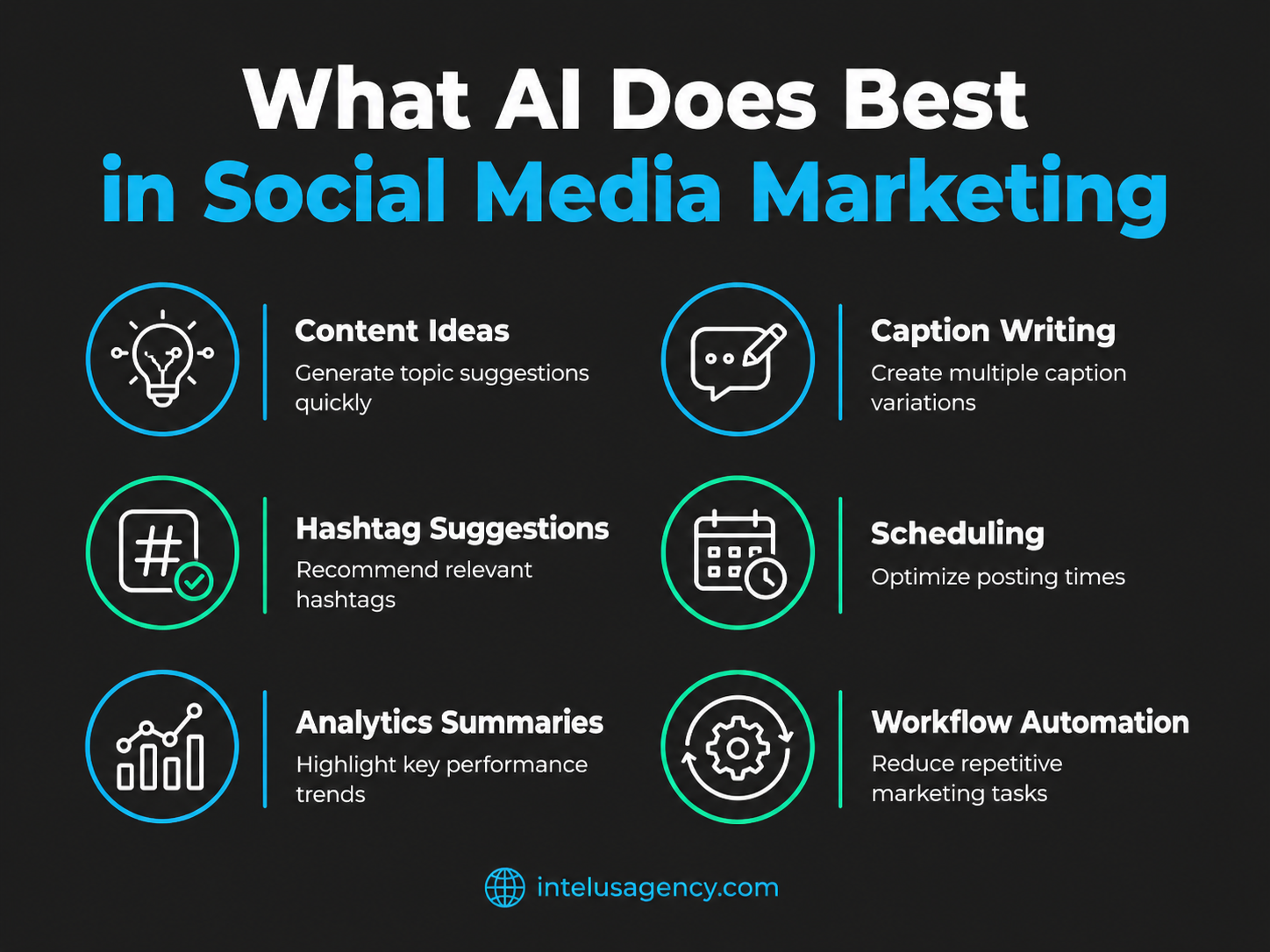
One of AI's biggest strengths is idea generation. It can quickly suggest content topics, write multiple caption variations, recommend relevant hashtags, and even repurpose long-form content into short social media posts. AI-powered scheduling platforms also help determine optimal posting times, while tools integrated with Freshsales CRM can organize customer interactions and summarize engagement data for faster decision-making.
AI also excels at processing large amounts of information. It can identify performance trends, summarize campaign analytics, detect audience activity patterns, and provide recommendations based on historical data. These capabilities significantly reduce the time marketers spend on manual reporting and administrative work.
Despite these advantages, AI delivers the greatest value when guided by experienced digital marketers who understand the broader business context. AI can generate content in seconds, but it cannot determine whether that content supports long-term brand positioning, business objectives, or customer relationships. Its speed improves execution, while human expertise ensures every marketing decision contributes to meaningful business growth. Organizations that combine both gain efficiency without sacrificing quality or strategy.
Where AI Falls Short
While AI is exceptionally good at accelerating content production, it still lacks the human qualities that make marketing truly effective. Social media is built on conversations, emotions, trust, and shared experiences, areas where algorithms have significant limitations.
One of AI's biggest weaknesses is emotional intelligence. It can analyze language patterns, but it cannot genuinely understand how people feel or anticipate the emotional impact of a message. This becomes especially important during sensitive situations, customer complaints, or public relations challenges, where empathy and thoughtful communication can protect a brand's reputation.
AI also struggles to capture a company's unique personality. It often produces content that is grammatically correct and well-structured but feels generic because it relies on existing patterns rather than original thinking. Distinctive brand voices, humor, and authentic storytelling are difficult to automate consistently.
Another challenge is cultural awareness. Internet trends, regional humor, social conversations, and audience expectations evolve rapidly. AI may miss subtle context, misunderstand cultural references, or unintentionally recommend messaging that feels out of touch. Human marketers recognize these nuances because they actively participate in the communities they serve.
Finally, AI cannot make business judgments. It does not understand changing priorities, competitive dynamics, customer relationships, or long-term brand positioning without human guidance. It can recommend what appears statistically effective, but it cannot determine whether a campaign aligns with broader business objectives.
These limitations do not make AI ineffective, they simply reinforce its role as an assistant. The most successful marketing strategies still depend on people to provide creativity, empathy, critical thinking, and the judgment required to turn content into meaningful customer relationships.
Why Human Strategy Still Wins
The value of experienced marketing managers extends far beyond publishing content. Effective social media marketing begins with understanding business goals, identifying the right audience, and developing campaigns that support measurable outcomes. While AI can assist with execution, it cannot create a strategy that balances customer needs, competitive positioning, and long-term business growth.
Imagine two businesses launching the same product on the same day. The first relies entirely on AI to generate captions, graphics, and posting schedules. The second uses AI for efficiency but places every decision in the hands of an experienced social media marketing manager. Instead of simply producing content, the manager studies audience behavior, selects the right messaging, coordinates launch timing, and adapts the campaign based on real-time feedback. Both businesses publish frequently, but only one creates conversations that strengthen customer trust and encourage lasting loyalty.
Human marketers also understand audience psychology. They know when to educate, entertain, inspire, or sell without overwhelming followers. They recognize subtle shifts in customer sentiment, identify opportunities to engage with trending conversations, and adjust campaigns before small issues become larger problems. These decisions rely on experience, intuition, and context, qualities that AI cannot replicate.
Community building is another area where human expertise makes a measurable difference. Responding thoughtfully to comments, nurturing customer relationships, collaborating with partners, and managing brand reputation all require genuine communication. Social media succeeds because people connect with people, not algorithms.
When AI and experienced digital marketers work together, businesses gain the best of both worlds. AI accelerates research, content creation, and reporting, while marketers transform those insights into campaigns that reflect brand values, strengthen customer relationships, and drive sustainable business growth. Strategy remains the competitive advantage that technology alone cannot provide.

The Best Approach: AI + Human Marketing Manager
The most successful businesses are not choosing between AI and human marketers, they are combining both. AI excels at handling repetitive, time-consuming tasks, while a social media marketing manager provides the strategic direction that ensures every campaign supports business objectives. This partnership allows companies to move faster without sacrificing quality, creativity, or brand consistency.
Instead of spending hours brainstorming captions or compiling reports, marketers can use AI to accelerate execution and focus on higher-value work such as campaign planning, audience engagement, and performance optimization. Businesses looking to improve efficiency while maintaining a strategic edge should consider an outsourcing consultation to determine how AI and experienced professionals can work together to support sustainable growth.
AI also becomes even more effective when integrated with customer data and marketing platforms such as Freshsales CRM. With stronger data organization, faster reporting, and automated workflows, marketing teams can make better-informed decisions while maintaining a consistent brand voice across every customer touchpoint.
The result is a balanced marketing approach: AI delivers speed, scalability, and operational efficiency, while human expertise ensures every piece of content reflects the company's goals, resonates with the target audience, and contributes to long-term business success. Rather than replacing marketers, AI empowers them to achieve stronger results with greater efficiency.
How to Choose the Right Social Media Marketing Manager
Hiring the right social media professional is about more than finding someone who can create attractive posts. An effective manager combines strategic thinking, communication skills, analytical ability, and a deep understanding of your target audience. Before making a decision, review a comprehensive marketing manager guide to better understand the skills and experience that contribute to long-term marketing success.
Start by evaluating their portfolio and past campaign results. Look for evidence that they have helped businesses achieve measurable goals such as increased engagement, qualified leads, stronger brand awareness, or improved conversions. Ask how they develop social media strategies, measure success, and adapt campaigns when performance changes.
It's also important to choose someone who understands how to use AI responsibly. The best marketers know how to leverage automation for efficiency while ensuring every campaign maintains an authentic brand voice and aligns with business objectives. Industry knowledge, clear communication, and the ability to translate data into actionable insights are equally valuable qualities.
Whether you hire in-house or partner with Intelus Agency, prioritize strategic expertise over content volume. A skilled social media marketing manager doesn't simply publish posts, they build relationships, strengthen your brand, and create marketing strategies that support sustainable business growth.
[INFOGRAPHIC: hiring-social-media-manager-checklist]
INFOGRAPHIC CONTENT (hiring-social-media-manager-checklist):
Title: Social Media Marketing Manager Hiring Checklist
Sections:
- Relevant Experience
- Review past campaigns and results
- Strategic Thinking
- Evaluate planning and goal alignment
- Portfolio
- Look for measurable business outcomes
- Communication Skills
- Assess collaboration and responsiveness
- AI Proficiency
- Verify responsible use of AI tools
- Industry Expertise
- Confirm knowledge of your market and audience
Conclusion
Artificial intelligence is reshaping social media marketing by making content creation, reporting, and workflow management faster than ever. However, technology alone cannot replace the strategic thinking, creativity, emotional intelligence, and business judgment that drive meaningful customer relationships and long-term growth.
The businesses that consistently outperform their competitors understand that AI is most valuable as a tool, not a substitute for human expertise. By combining AI-powered efficiency with an experienced social media marketing manager, organizations can create smarter campaigns, maintain a consistent brand voice, and achieve stronger business outcomes.
If your current social media efforts are focused more on producing content than delivering strategy, now is the time to rethink your approach. Explore an outsourcing consultation to discover how experienced marketers and AI can work together to accelerate your business growth.


.png)
.png)
.png)
.png)
.png)
