



Oops! Something went wrong while submitting the form.
Account Management is one of the most overlooked growth drivers inside agencies. Teams chase new deals, celebrate signed contracts, and then quietly move on to the next opportunity. Meanwhile, existing clients are left wondering what happens after the sale. This is where Account Management either builds trust or slowly breaks it.
Strong Account Management turns clients into long-term partners. Weak Account Management turns good work into lost accounts. The difference is rarely talent or effort. It’s structure, ownership, and communication. When agencies get this right, growth becomes predictable instead of stressful. When they don’t, churn shows up without warning.
This article breaks down how Account Management drives trust, retention, and results, and why agencies that invest here scale faster with fewer fires to put out.
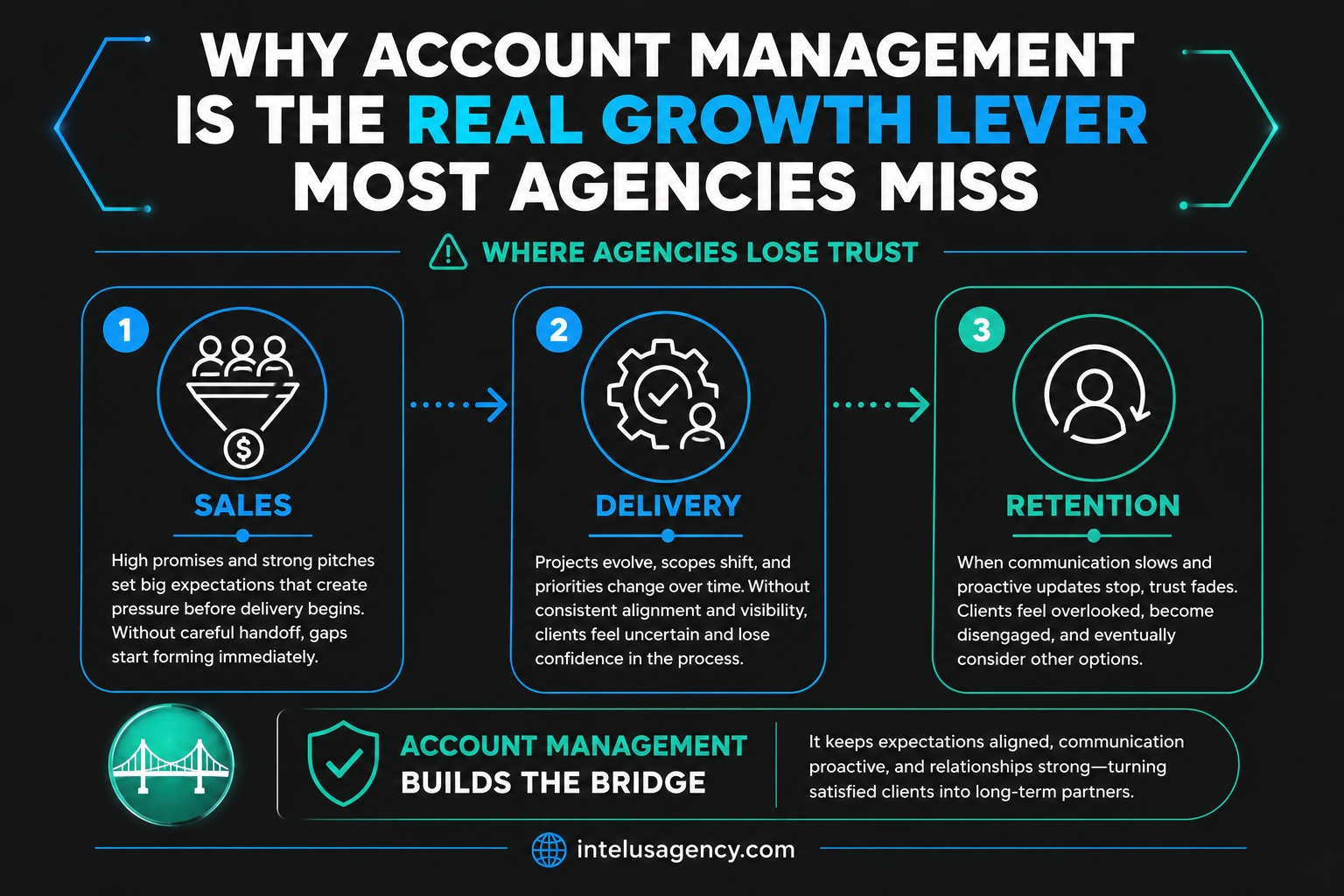
Why Account Management Is the Real Growth Lever Most Agencies Miss
Most agencies invest heavily in sales. Pipelines, funnels, outreach, and closing strategies get constant attention. What gets far less focus is relationship ownership after the deal is signed. That imbalance creates instability.
Client churn is rarely about poor performance alone. More often, it’s caused by misalignment, unclear expectations, or long stretches of silence. Clients don’t leave because one thing went wrong. They leave because they stop feeling confident.
Account Management is the bridge between what was promised and what clients experience day to day. It ensures expectations stay aligned as projects evolve. Strong Account Management stabilizes revenue before new clients are added, which is why agencies that prioritize it grow with far less volatility.
Many of the most effective client relationship management best practices emphasize ownership and proactive communication, including frameworks taught in leadership programs focused on long-term relationship value rather than short-term wins.
Why Client Trust Is Built Between Meetings, Not During Them
Most agencies believe trust is built during kickoff calls, quarterly reviews, or big presentations. Those moments matter, but they aren’t where trust actually forms. Trust is built in the quiet space between meetings.
Clients judge confidence based on what happens when they’re not talking to you. Silence creates uncertainty, even when work is moving forward. A client who hasn’t heard anything starts to wonder if priorities have shifted or if problems are being hidden.
Proactive updates change that feeling completely. When an Account Manager shares progress before being asked, it lowers anxiety and builds confidence. Consistency matters more than perfection. Clients don’t need polished updates. They need reliable ones.
This kind of communication works best when paired with strong project management leadership, where timelines, ownership, and expectations are clearly defined. It also aligns with broader thinking around building customer trust, which consistently highlights transparency and predictability as the foundation of confidence.
Account Management vs. Customer Support: The Difference That Changes Everything
Customer support and Account Management are often treated as the same thing, but they solve very different problems. Support reacts when something breaks. Account Management works to prevent things from breaking in the first place.
Support teams focus on tickets, requests, and fixes. Account Managers focus on outcomes. They look ahead, identify risks, and make sure the client’s goals stay front and center across teams.
When support is the only client-facing role, clients don’t feel managed. They feel processed. True Account Management advocates for the client internally, ensuring priorities are understood and expectations are met long before issues surface.
This shift from reactive to proactive ownership is what turns service delivery into a relationship instead of a transaction.
How Strong Account Management Protects Revenue You’ve Already Earned
Retention is the most efficient growth lever agencies have, yet it’s often ignored. Winning new clients is expensive. Keeping existing ones is far more profitable, but only if relationships are actively managed.
Strong Account Management surfaces risks early. When engagement drops or feedback changes, Account Managers notice and act before frustration builds. Sometimes that means resetting expectations. Other times it means adjusting scope or improving communication.
Expansion becomes easier when trust already exists. Clients who feel supported are far more open to adding services or increasing investment. Clear account ownership reduces churn caused by confusion rather than results.
This connection between trust and growth is reinforced by proven customer retention strategies, which consistently show that proactive relationship management outperforms reactive problem-solving.
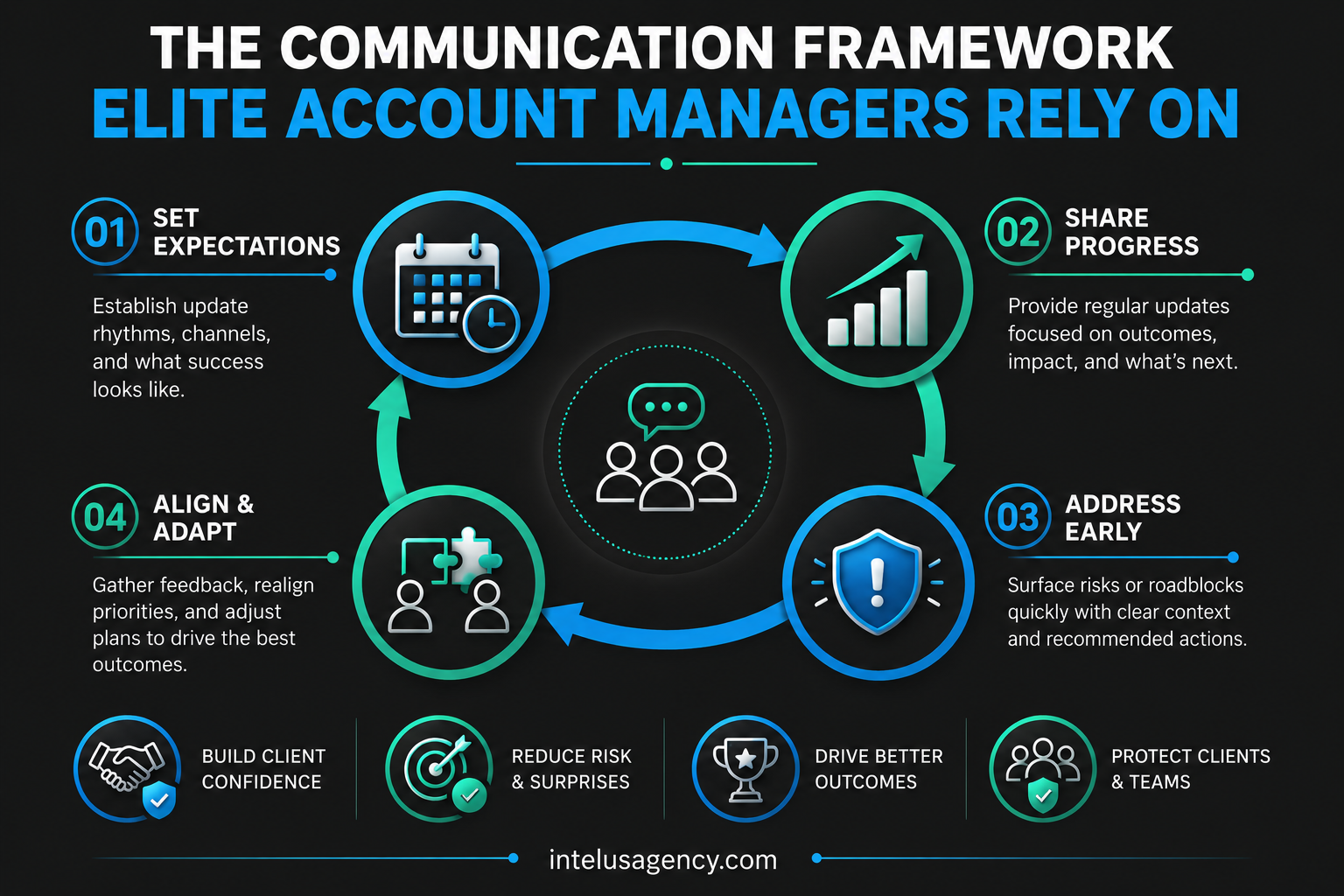
The Communication Framework Elite Account Managers Rely On
Great Account Management isn’t about personality. It’s about systems. Cadence beats charisma every time. Predictable communication builds confidence because clients know what’s coming and when.
Elite Account Managers rely on clear frameworks. They establish update rhythms, define escalation paths, and translate delivery work into language clients understand. Instead of listing tasks, they explain progress in terms of outcomes and impact.
Frameworks prevent relationships from relying on memory or heroics. When everything lives in someone’s head, trust breaks the moment that person is unavailable. Process-driven communication protects both clients and teams.
This approach fits naturally with process-driven delivery models and aligns with widely adopted customer success best practices, where consistency and clarity matter more than charm.
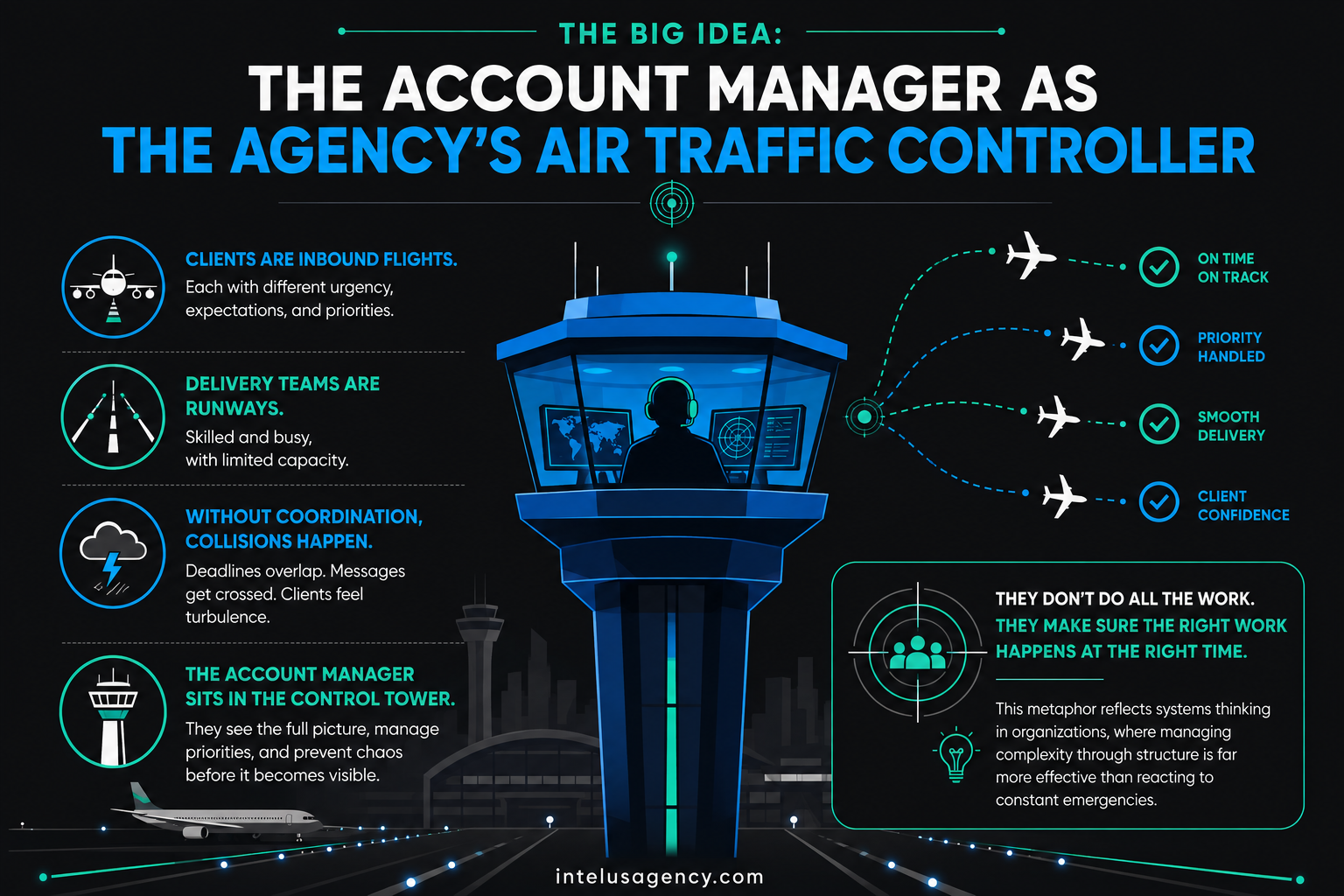
The Big Idea: The Account Manager as the Agency’s Air Traffic Controller
Picture your agency as an airport. Clients are inbound flights, each with different urgency, expectations, and priorities. Delivery teams are runways with limited capacity. Everyone is skilled, and everyone is busy.
Without coordination, collisions happen. Deadlines overlap. Messages get crossed. Clients feel turbulence before anyone realizes there’s a problem.
The Account Manager sits in the control tower. They see the full picture, manage priorities, and prevent chaos before it becomes visible. They don’t do all the work. They make sure the right work happens at the right time.
This metaphor reflects systems thinking in organizations, where managing complexity through structure is far more effective than reacting to constant emergencies.
Why Most Agencies Fail at Account Management as They Scale
In early stages, founders often manage client relationships themselves. It feels personal and efficient. Over time, it becomes a bottleneck. Relationships depend on one person, and no one else fully owns the experience.
In many agencies, account responsibilities are spread across sales, delivery, and support. When everyone owns a piece, no one owns the whole. Clients feel this fragmentation even if they can’t explain it.
Growth magnifies communication gaps. What worked with five clients breaks at twenty. Without dedicated Account Management, small issues repeat and trust erodes quietly.
These patterns mirror common leadership challenges in growing businesses, where lack of ownership creates burnout, confusion, and preventable churn.
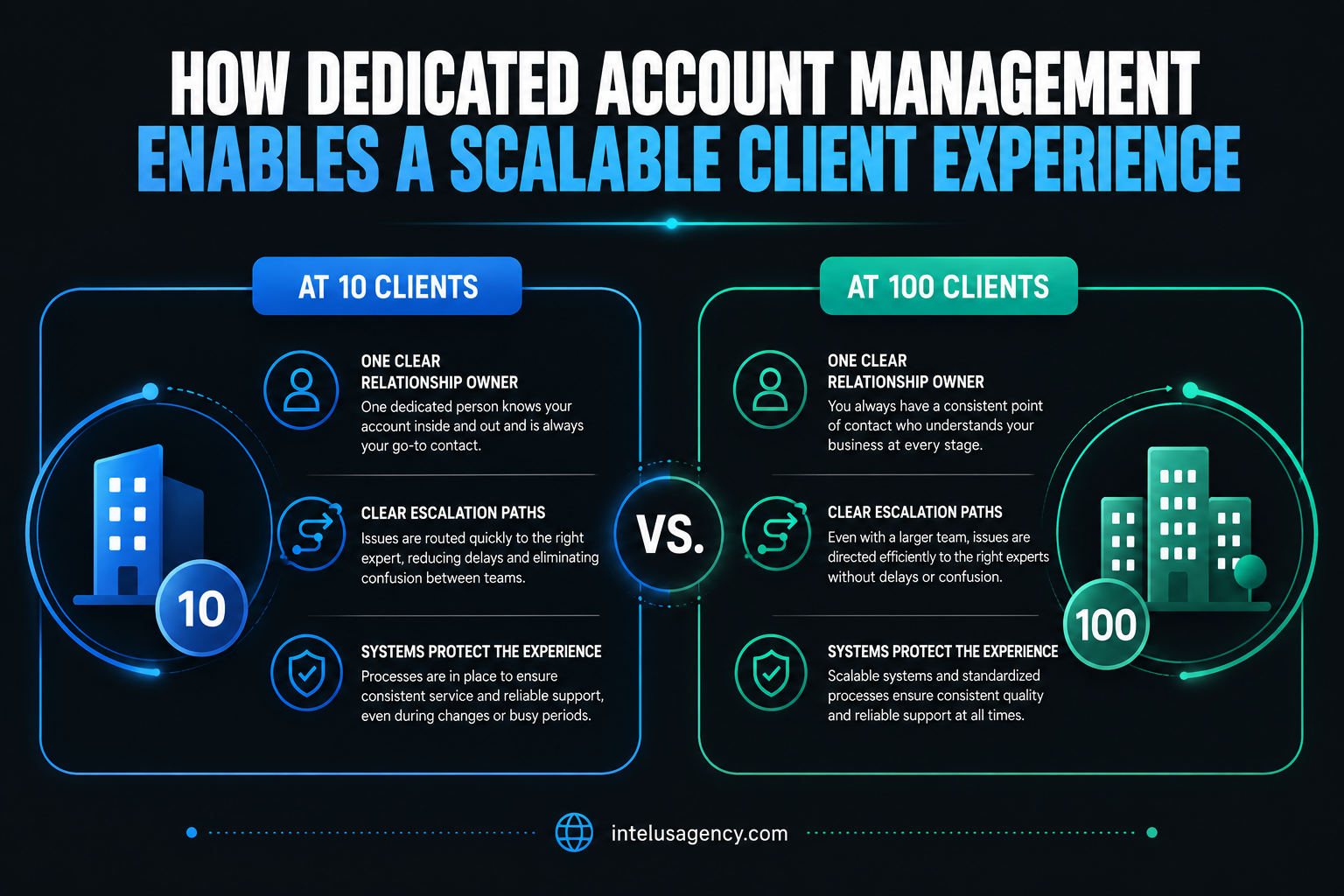
How Dedicated Account Management Enables a Scalable Client Experience
Dedicated Account Management creates stability. One clear relationship owner per account means clients always know who to contact. Clear escalation paths reduce tension because problems don’t bounce between departments.
Even as teams change, clients feel continuity. Systems protect the experience during growth, ensuring trust doesn’t depend on individual memory or availability.
This structure supports long-term consistency and reflects modern customer experience strategy, where scalable systems protect relationships as organizations grow.
Account Management Is the Promise You Keep After the Sale
Sales sets expectations. Account Management sustains belief. Trust compounds over time when ownership is clear and communication is consistent. Strong Account Management reduces churn long before it appears in metrics.
Agencies that invest here don’t just grow faster. They grow calmer. Teams stay aligned. Clients stay confident.
For agencies ready to strengthen this function, it starts with knowing how to hire account management support that’s trained for ownership, not just coordination. And for those focused on retention and growth, learning how to build long-term client partnerships with the right systems and talent makes growth sustainable instead of stressful.
Account Management isn’t just a role. It’s the promise you keep after the sale, and the foundation that turns good work into lasting trust.


