



Oops! Something went wrong while submitting the form.
Social media is one of the biggest growth levers for agencies, and one of the fastest paths to burnout. Many agency owners start by running social media themselves. At first it feels manageable. Then clients increase, platforms change, posting schedules slip, and suddenly social media becomes a daily source of stress.
This is where structured social media management support changes everything, turning scattered content, engagement, and reporting tasks into a consistent process. Not as a junior task-doer, but as a strategic support role that protects your time, creates consistency, and allows your agency to scale without chaos.
Hiring a social media assistant isn’t about giving up control. It’s about building a system that works even when you’re not personally involved in every post.
How a Social Media Assistant Can Grow Your Business
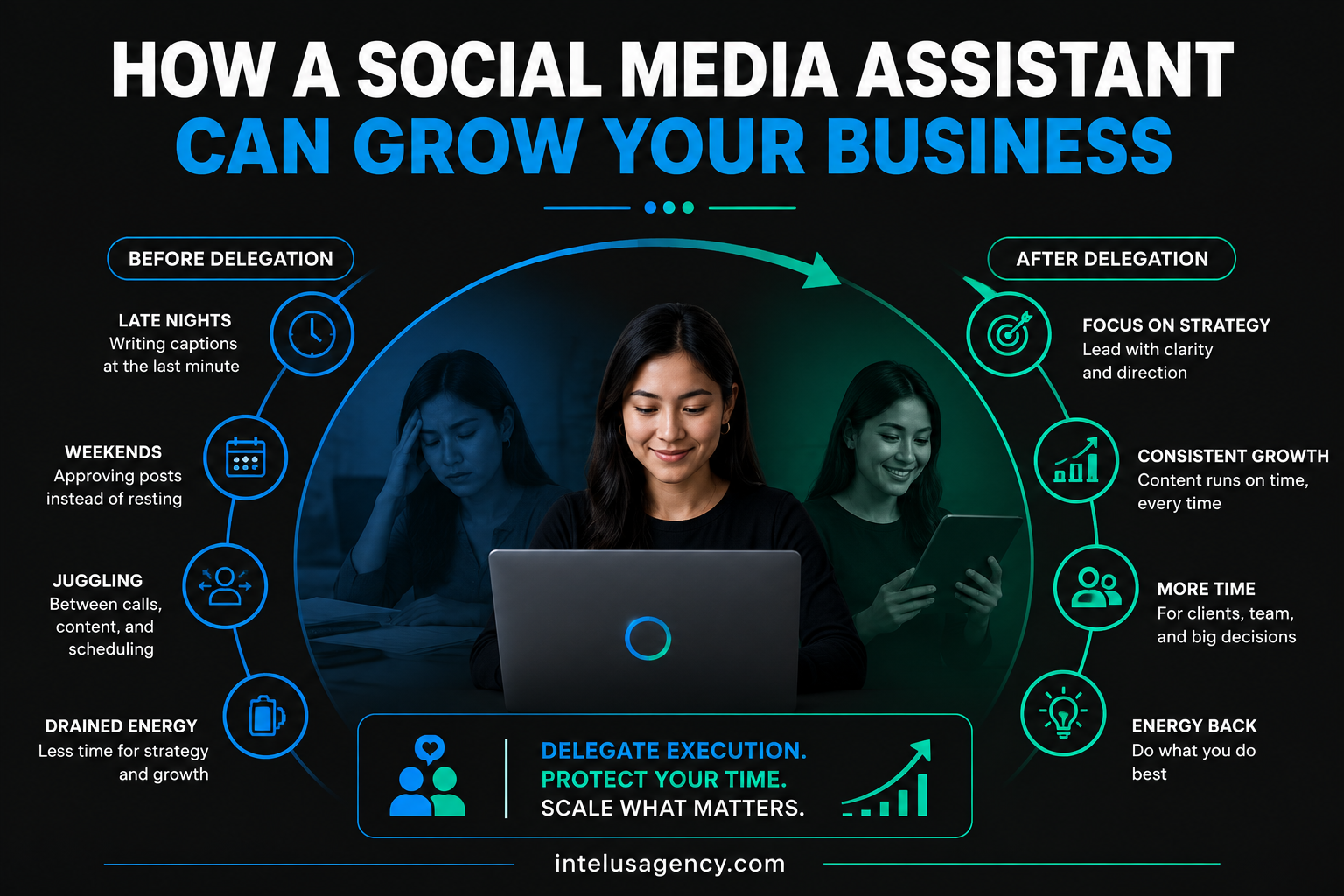
Most agency owners are stuck in execution. They’re writing captions late at night, approving posts on weekends, and jumping between strategy calls and content scheduling. Over time, this slows growth and drains energy.
A social media assistant reframes this problem. Instead of social media being something you squeeze in, it becomes a repeatable process that runs in the background. When agencies partner with a virtual assistant staffing agency, they’re able to delegate execution while keeping strategy and creative direction in-house.
This shift aligns with how high-performing leaders protect their time. Research on Managing Founder Time consistently shows that growth stalls when leaders stay trapped in day-to-day execution instead of focusing on direction and decisions.
The Real Cost of Doing Social Media Yourself (or Delegating It Poorly)
The cost of doing social media yourself isn’t just the hours spent posting. It’s the opportunity cost of what you’re not doing during that time. Every hour spent scheduling content is an hour not spent closing deals, refining offers, or building partnerships.
Delegating poorly creates a different problem. Inconsistent freelancers, unclear expectations, and missed deadlines lead to uneven results. One month looks great. The next month goes silent. Clients notice this inconsistency immediately.
Operational drag like this is common in professional services. Studies on operational efficiency in professional services show that inconsistent execution often costs more in lost trust and momentum than it saves in short-term labor costs.
A social media assistant solves this by creating ownership and consistency instead of fragmented effort.
What a Social Media Assistant Actually Does (Beyond Posting)
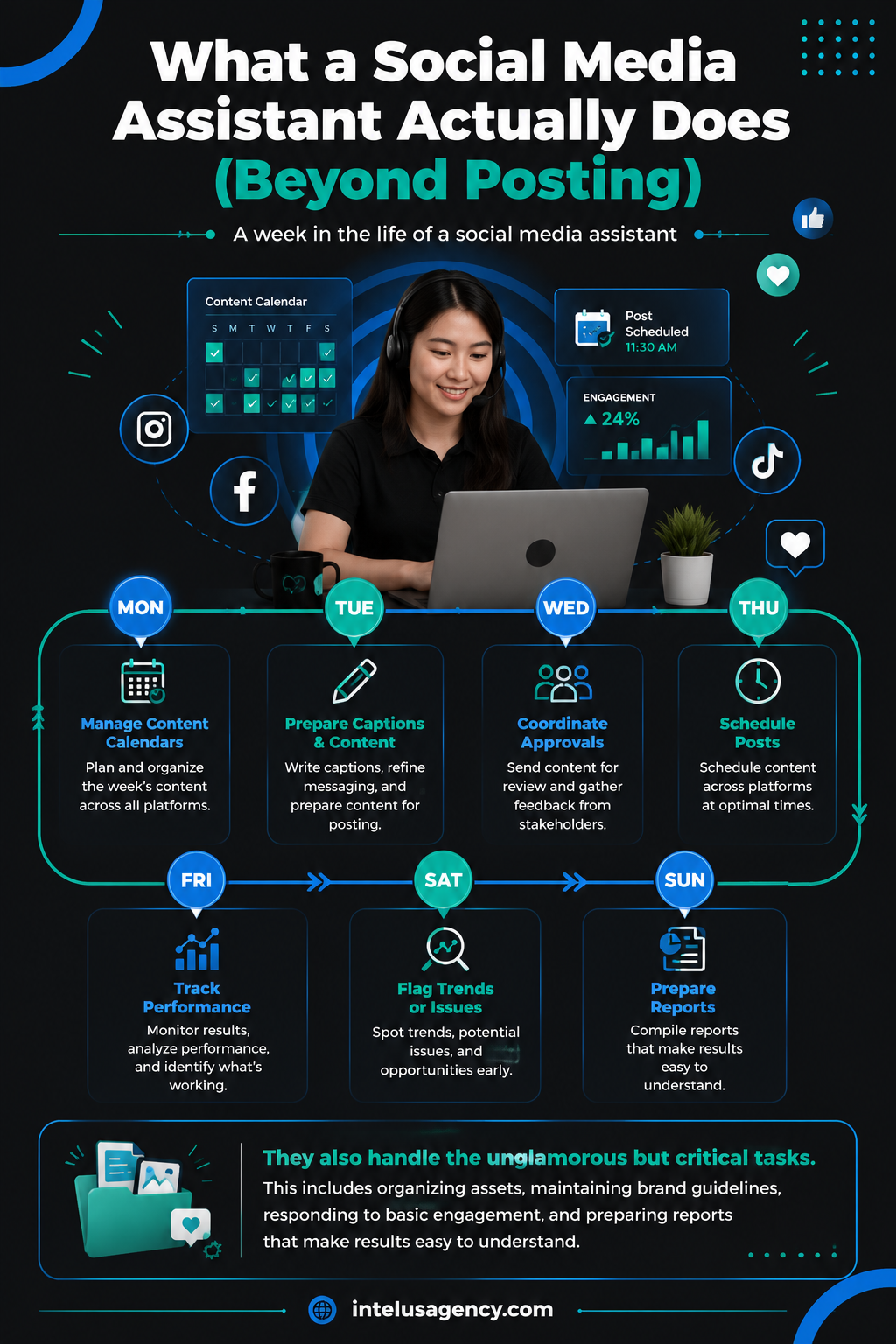
Many agency owners think a social media assistant just posts content. In reality, a modern social media assistant supports the entire content engine. They manage content calendars, prepare captions, coordinate approvals, schedule posts, track performance, and flag trends or issues before they become problems.
They also handle the unglamorous but critical tasks. This includes coordinating graphic design support for branded social media assets, maintaining brand guidelines, responding to basic engagement, and preparing reports that make results easy to understand.
This level of support fits naturally into broader social media marketing support structures, where assistants execute within systems instead of guessing what to do next. It aligns closely with how Social Media Manager Responsibilities are defined in mature marketing teams and how performance is measured against social media management benchmarks used by high-performing brands.
How a Social Media Assistant Helps Agencies Scale Faster
Scaling an agency isn’t just about signing more clients. It’s about delivering consistently as volume increases. Social media assistants increase capacity without increasing chaos.
When execution is delegated, agencies stop bottlenecking around one person. Content goes out on time. Engagement stays consistent. Clients feel supported instead of forgotten.
This is why many agencies rely on remote staffing solutions for agencies to expand delivery without committing to risky full-time hires. Others choose to hire virtual assistants for marketing teams so they can add capacity quickly as new clients come on board.
Industry insights around agency growth strategies repeatedly show that scalable delivery systems matter more than individual talent when agencies move from small to mid-sized.
The Systems That Make a Social Media Assistant Successful
Talent alone doesn’t create results. Systems do. A social media assistant performs best when workflows are clear and repeatable. Ideas flow into a content calendar. Content moves through review. Posts are scheduled. Performance is tracked and reported.
Without systems, assistants guess. With systems, they execute confidently.
This is where pairing a social media assistant with a project management virtual assistant becomes powerful. Together, they ensure deadlines are met, handoffs are smooth, and nothing falls through the cracks.
Proven social media workflow templates show that consistency beats creativity over time. When systems are in place, creativity actually improves because it’s no longer rushed.
The Big Idea — Your Social Media Assistant Is the Gardener, Not the Artist
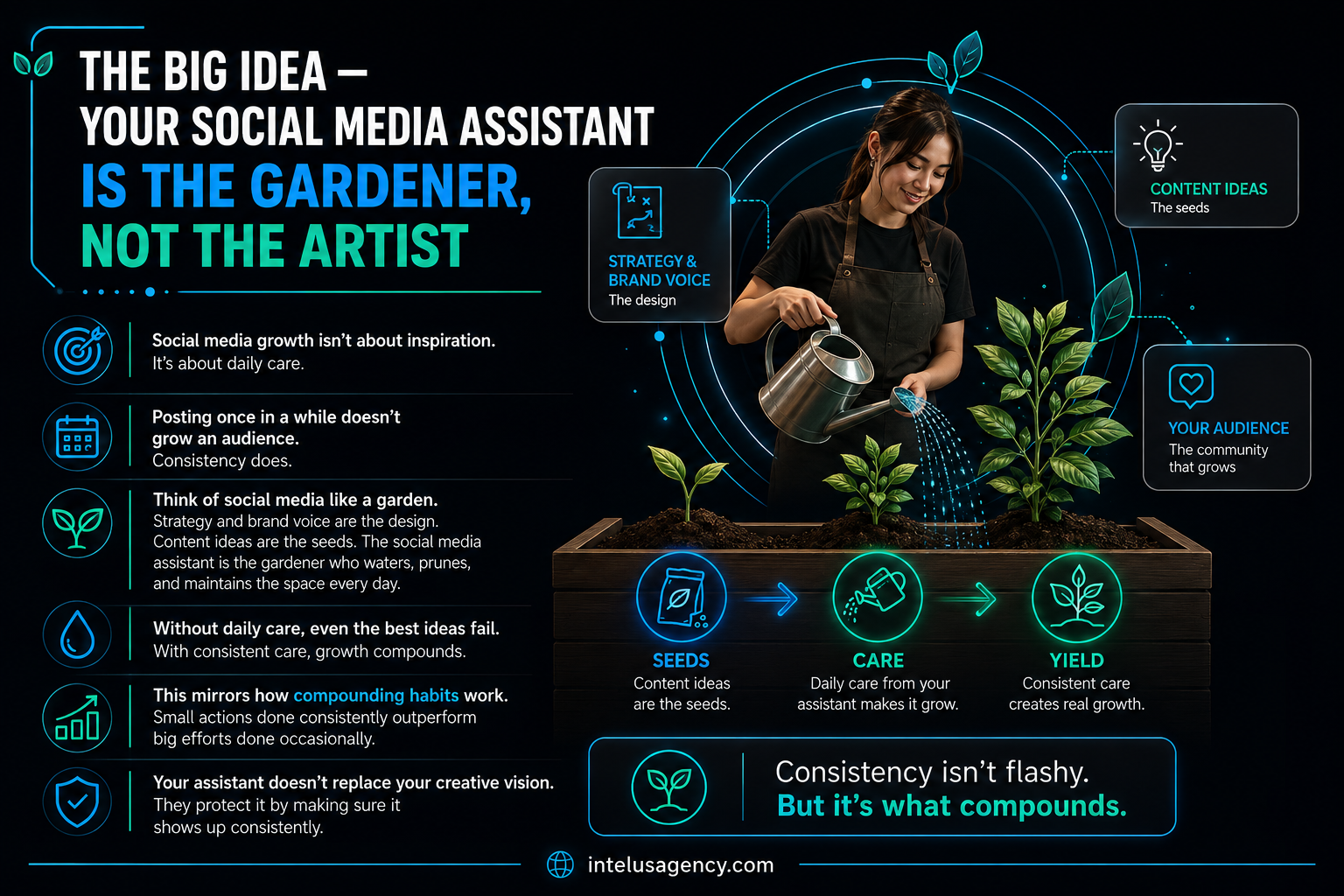
Social media growth isn’t about inspiration. It’s about daily care. Posting once in a while doesn’t grow an audience. Consistency does.
Think of social media like a garden. Strategy and brand voice are the design. Content ideas are the seeds. The social media assistant is the gardener who waters, prunes, and maintains the space every day.
Without daily care, even the best ideas fail. With consistent care, growth compounds. This mirrors how compounding habits work. Small actions done consistently outperform big efforts done occasionally.
Your assistant doesn’t replace your creative vision. They protect it by making sure it shows up consistently.
When Is the Right Time to Hire a Social Media Assistant?
Most agencies wait too long. If social media feels stressful, inconsistent, or constantly behind, that’s a signal. If you’re approving posts late at night or skipping content altogether, that’s another.
The right time isn’t when you’re overwhelmed. It’s when social media is important enough that inconsistency is costing you credibility. Many agencies start by deciding to hire a virtual assistant before social media becomes a source of churn or missed opportunities.
Delegating early creates space for growth instead of reacting to burnout later.
Why Agencies Are Turning to Remote Social Media Assistants
Remote assistants offer flexibility that traditional hiring can’t. Agencies avoid long-term commitments while gaining reliable support. Time zone coverage improves responsiveness. Costs stay predictable.
Research into distributed teams supports this shift. Insights from Deloitte – Remote work productivity insights show that well-structured remote roles often outperform traditional setups. Studies on engagement from Gallup – Employee engagement and distributed teams highlight how clarity and ownership matter more than physical location.
Remote social media assistants fit modern agency workflows better than in-house roles that rely on constant supervision.
Final Thoughts — Growth Comes From Delegation, Not Hustle
Agencies don’t scale by working harder. They scale by working smarter. A social media assistant turns scattered effort into a system. It protects founder time, improves consistency, and increases capacity without burnout.
If social media feels like a constant drain, that’s not a discipline problem. It’s a delegation problem. The next step isn’t another tool or template. It’s the right support.
For agencies ready to move forward, the simplest way to start is to talk to a talent matching specialist and map out what delegation could look like with the right systems and role-trained support in place.
Growth doesn’t come from hustle alone. It comes from building a team that allows your agency to show up consistently, confidently, and sustainably.


.png)
.png)

.png)
.png)
