



Oops! Something went wrong while submitting the form.
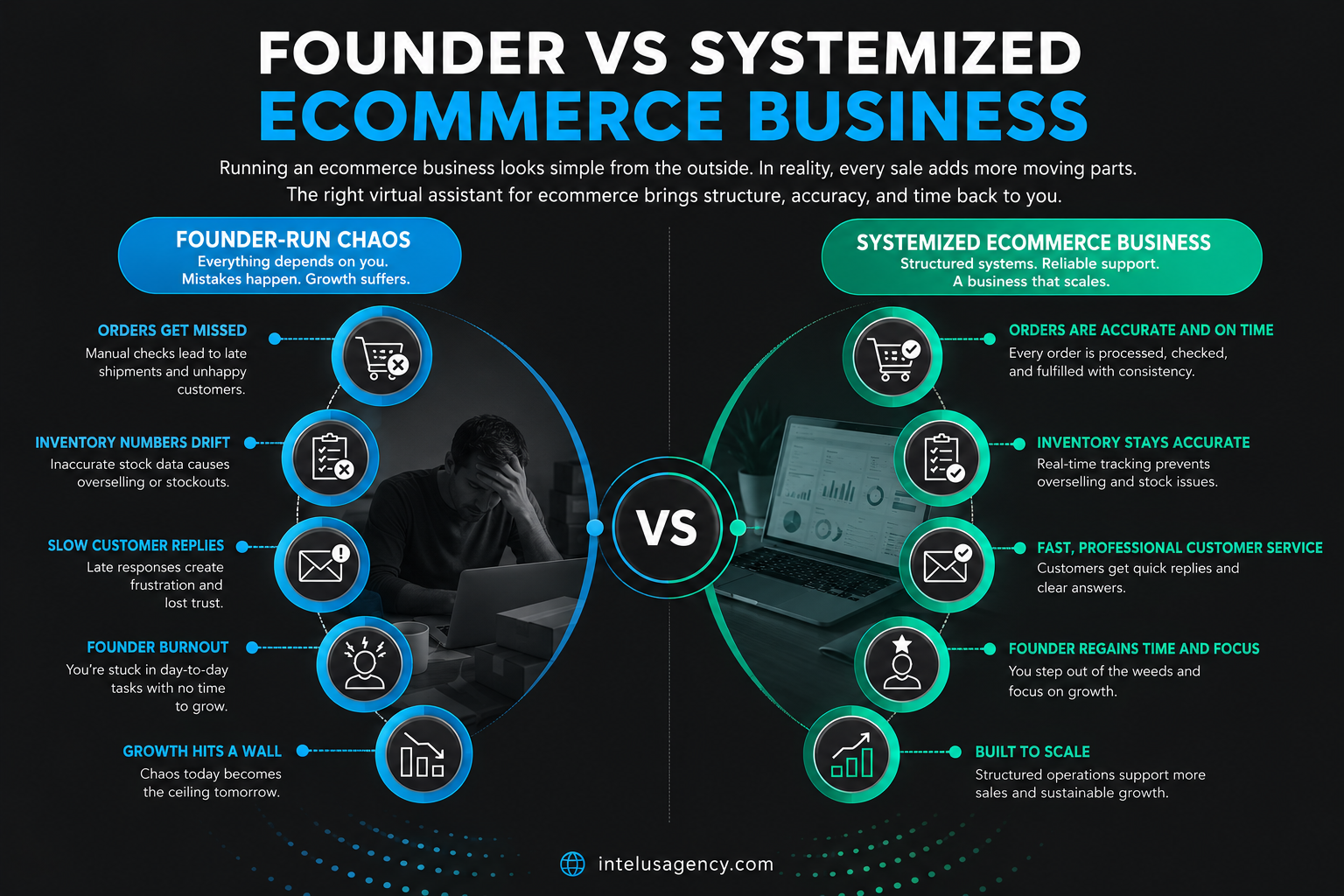
Running an ecommerce business looks simple from the outside. Products go live, customers click buy, and money shows up in your account. In reality, every sale adds more moving parts. Orders need to be checked. Inventory has to stay accurate. Customers want fast replies and clear answers. When founders try to manage all of this alone, things start to crack. Orders get missed. Inventory numbers drift. Customer trust takes a hit.
This is why more store owners choose to hire role-trained virtual assistants who handle the operational load so the business can actually scale. A virtual assistant for ecommerce isn’t just extra hands. They’re leveraged. They turn chaos into systems and help founders get back control of their time.
As volume increases, ecommerce operations often break because they were never designed to scale. Most stores start with manual processes. The founder handles orders in the morning, answers emails at night, and checks inventory when something goes wrong. This works at ten orders a day. It fails at a hundred. The hidden cost isn’t just mistakes. It’s burnout. When you’re stuck inside the business all day, you lose the space to grow it.
A virtual assistant restores focus by owning the day-to-day work. Instead of reacting to problems, you operate with structure. Instead of being everywhere at once, you manage from the top. With the right Remote operations support, ecommerce stops feeling like a constant emergency.
What Does a Virtual Assistant for Ecommerce Actually Do?
Many store owners think virtual assistants only handle basic admin tasks. That’s one of the biggest misconceptions. A virtual assistant for ecommerce is involved in the real engine of the business. They touch orders, inventory, systems, and customers every single day.
Order processing and fulfillment coordination is usually the first responsibility. A VA reviews incoming orders, checks for issues, and ensures everything flows correctly to your fulfillment partner or warehouse. They keep orders moving instead of letting them pile up.
Inventory updates across platforms are another major task. Whether you sell on Shopify, Amazon, or multiple channels, a VA keeps stock levels accurate so you don’t oversell or disappoint customers. When inventory stays clean, cash flow becomes easier to manage.
Customer inquiries, refunds, and returns are handled daily. Instead of waking up to a full inbox, your VA responds to customers, processes refunds, and follows clear workflows to resolve issues quickly. This protects your brand and your reviews.
Many ecommerce VAs also handle product uploads and listing optimization. They make sure descriptions are accurate, SKUs are organized, and backend systems stay clean. Over time, this kind of operational virtual assistant support creates stability that most founders don’t realize they’re missing.
If you want a broader look at how ecommerce operations work at scale, the BigCommerce Operations Guide offers useful background on how systems and processes support growing stores. When paired with structured internal execution, those ideas actually become usable.
How a Virtual Assistant Simplifies Ecommerce Order Management
Order management is where small mistakes become big problems. One missed order turns into a support ticket. One delayed shipment turns into a chargeback. Multiply that by dozens of orders a day, and the stress adds up fast.
A virtual assistant for ecommerce verifies orders as they come in. They flag exceptions, check addresses, and handle edge cases before they become customer complaints. This extra layer of review dramatically reduces errors.
They also coordinate with fulfillment partners and 3PLs so orders don’t get stuck in limbo. If something goes wrong, your VA catches it early and communicates clearly with both your team and your customers.
Backorders and partial shipments are another hidden headache. Without a system, these issues slip through the cracks. A VA tracks these situations and makes sure customers know what’s happening, which protects trust and reduces disputes.
Over time, consistent order management lowers chargebacks and payment disputes. When customers feel informed and supported, they’re less likely to escalate issues. This is where process-driven virtual assistants create real financial value, not just convenience.
For a deeper look at how fulfillment workflows should run, ShipBob’s fulfillment process guide explains the systems behind efficient order handling. A VA ensures those systems are actually followed day to day.
Inventory Management Without the Headaches
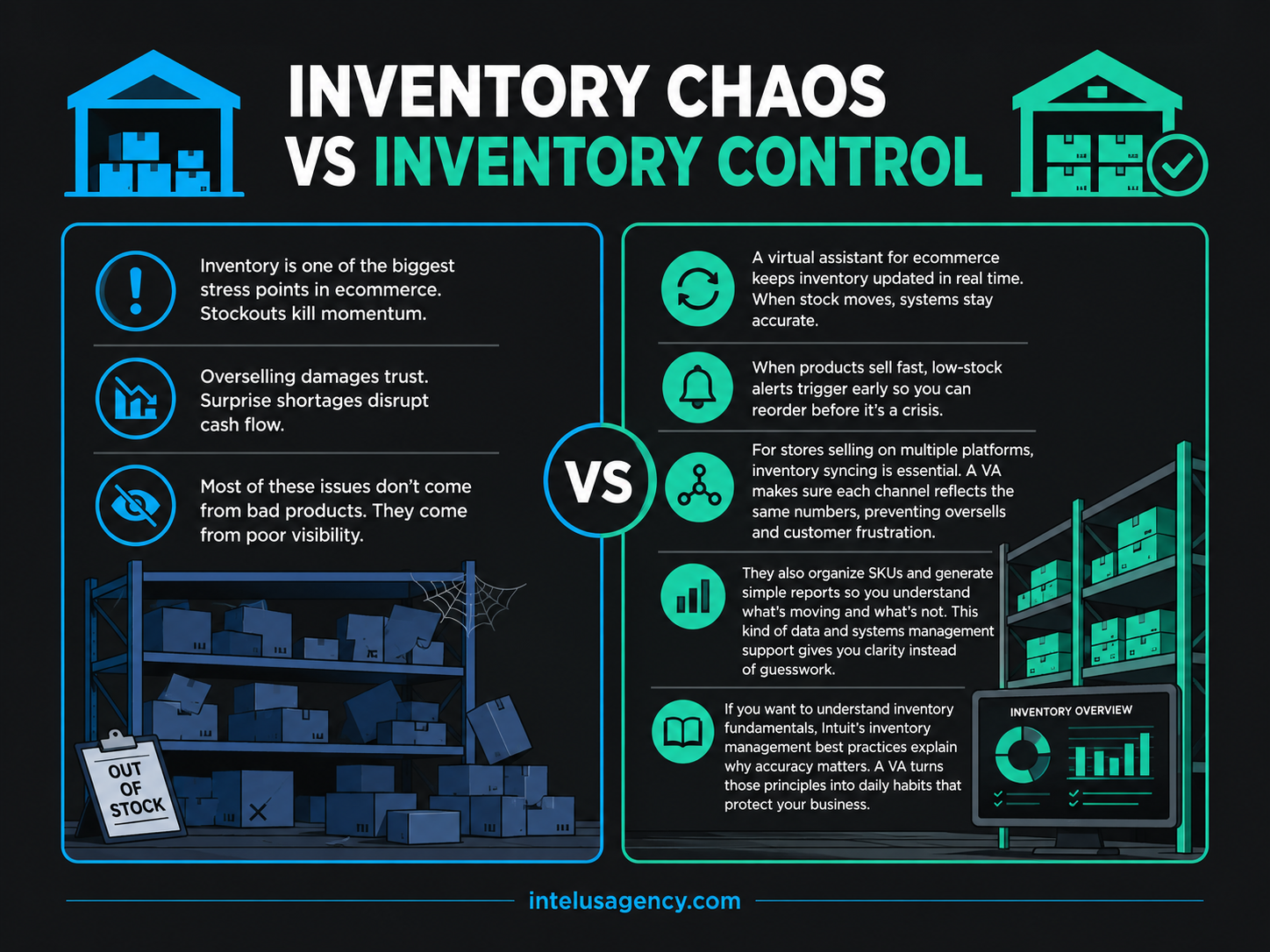
Inventory is one of the biggest stress points in ecommerce. Stockouts kill momentum. Overselling damages trust. Surprise shortages disrupt cash flow. Most of these issues don’t come from bad products. They come from poor visibility.
A virtual assistant for ecommerce keeps inventory updated in real time. When stock moves, systems stay accurate. When products sell fast, low-stock alerts trigger early so you can reorder before it’s a crisis.
For stores selling on multiple platforms, inventory syncing is essential. A VA makes sure each channel reflects the same numbers, preventing oversells and customer frustration.
They also organize SKUs and generate simple reports so you understand what’s moving and what’s not. This kind of data and systems management support gives you clarity instead of guesswork.
If you want to understand inventory fundamentals, Intuit’s inventory management best practices explain why accuracy matters. A VA turns those principles into daily habits that protect your business.
Ecommerce Customer Service That Scales Without Burning You Out
Customer service often gets treated like a cost center, but it’s really a revenue protector. Slow responses lose trust. Poor communication creates refunds and negative reviews. Strong support keeps customers coming back.
A virtual assistant for ecommerce manages inboxes and live chat so customers never feel ignored. They respond quickly, follow brand guidelines, and escalate issues only when needed.
Refunds and exchanges are handled through clear workflows instead of emotional decisions. This keeps policies consistent and fair.
Response time standards matter more than most founders realize. A VA helps maintain SLAs so customers know what to expect. That consistency builds credibility.
When communication sounds like your brand, customers feel confident. That’s why customer support virtual assistants are trained to speak in your voice, not generic scripts.
The Big Idea: Your Ecommerce Business as a Control Tower
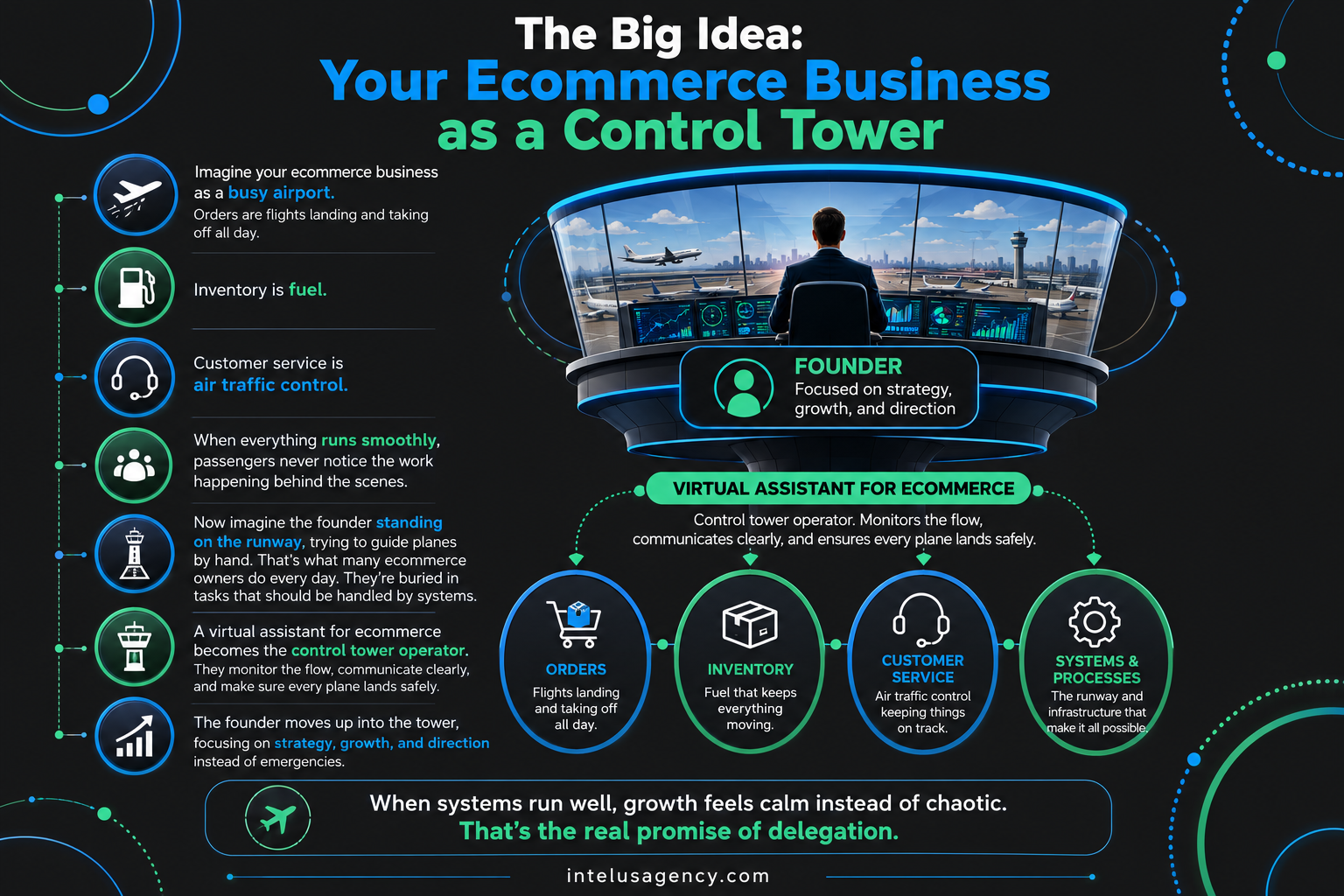
Imagine your ecommerce business as a busy airport. Orders are flights landing and taking off all day. Inventory is fuel. Customer service is air traffic control. When everything runs smoothly, passengers never notice the work happening behind the scenes.
Now imagine the founder standing on the runway, trying to guide planes by hand. That’s what many ecommerce owners do every day. They’re buried in tasks that should be handled by systems.
A virtual assistant for ecommerce becomes the control tower operator. They monitor the flow, communicate clearly, and make sure every plane lands safely. The founder moves up into the tower, focusing on strategy, growth, and direction instead of emergencies.
When systems run well, growth feels calm instead of chaotic. That’s the real promise of delegation.
When Should You Hire a Virtual Assistant for Ecommerce?
Most founders wait too long. They tell themselves they’ll hire help once things settle down. The truth is, things don’t settle down on their own.
If orders are slipping through the cracks, inventory surprises keep happening, or customer support feels overwhelming, it’s time. If you’re working nights and weekends just to keep up, you’re already paying the price.
Growth often stalls because operations can’t keep up. Hiring a virtual assistant fast gives you breathing room before burnout sets in.
Why Role-Trained Ecommerce Virtual Assistants Matter
Not all VAs are the same. Generic marketplaces give you resumes, not solutions. Role-trained ecommerce virtual assistants come with platform experience, SOP-driven execution, and communication standards already in place.
They don’t guess. They follow systems. They’re supported by ongoing performance oversight, so quality stays consistent as your business grows.
This is what separates Intelus Agency from typical staffing options. The focus isn’t just filling a role. It’s building a dependable operation.
Conclusion
A virtual assistant for ecommerce isn’t about doing less work. It’s about doing the right work. When daily operations are handled, founders regain clarity, energy, and momentum.
If you want to build a business that doesn’t depend on you being everywhere at once, it starts with support. You don’t need more hustle. You need better systems and the right people running them.
If you’re ready to move from chaos to control, it may be time to talk to an ecommerce virtual assistant specialist and build an operation that actually works without burning you out.


.png)
.png)